







Question: Using Table 3.2, discuss potential safety issues associated with the usage of hydrogen as a fuel for automobiles running on fuel cells in comparison with
Using Table 3.2, discuss potential safety issues associated with the usage of hydrogen as a fuel for automobiles running on fuel cells in comparison with those associated with vehicles running on gasoline.
Table 3.2:-
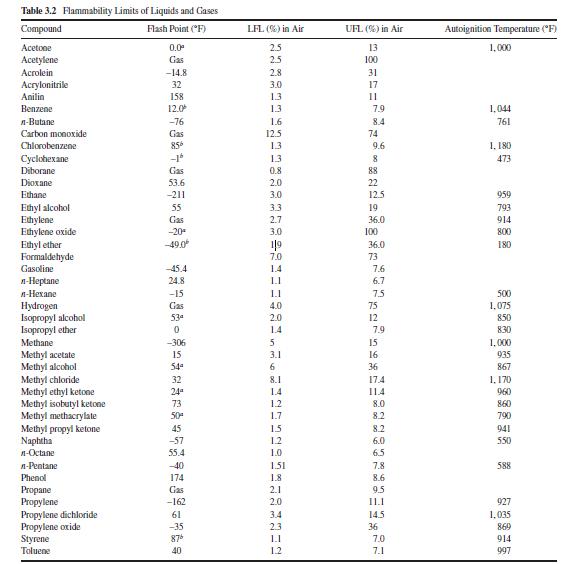
Table 3.2 Flammability Limits of Liquids and Gases Compound Acetone Acetylene Acrolein Flash Point (F) LFL (%) in Air UFL (%) in Air Autoignition Temperature (F) 0.0 2.5 Gas 2.5 13 100 1,000 -14.8 2.8 31 Acrylonitrile 32 3.0 17 Anilin 158 1.3 11 Benzene 12.0 13 7.9 1,044 -Butane -76 1.6 8.4 761 Carbon monoxide Gas 12.5 74 Chlorobenzene 856 1.3 9.6 1.180 Cyclohexane -1 13 8 473 Diborane Gas 0.8 88 Dioxane 53.6 2.0 22 Ethane -211 3.0 12.5 959 Ethyl alcohol 55 3.3 19 793 Ethylene Gas 2.7 36.0 914 Ethylene oxide -20 3.0 100 800 Ethyl ether -49.0 119 36.0 180 Formaldehyde 7.0 73 Gasoline -45.4 1.4 7.6 n-Heptane 24.8 6.7 n-Hexane -15 1.1 75 500 Hydrogen Gas 4.0 75 1,075 Isopropyl alcohol 53 2.0 12 850 Isopropyl ether 0 1.4 7.9 830 Methane -306 5 15 1,000 Methyl acetate 15 3.1 16 Methyl alcohol 54 6 66 935 36 867 Methyl chloride 32 8.1 17.4 1,170 Methyl ethyl ketone 24 1.4 11.4 960 Methyl isobutyl ketone 73 1.2 8.0 860 Methyl methacrylate 50 1.7 8.2 790 Methyl propyl ketone 45 15 8.2 941 Naphtha -57 12 6.0 550 -Octane 55.4 1.0 6.5 n-Pentane -40 1.51 7.8 588 Phenol 174 1.8 8.6 Propane Gas 2.1 9.5 Propylene -162 2.0 11.1 927 Propylene dichloride 61 3.4 14.5 1,035 Propylene oxide -35 2.3 Styrene 87 1.1 Toluene 40 1.2 129 36 869 7.0 914 7.1 997
Step by Step Solution
There are 3 Steps involved in it

Get step-by-step solutions from verified subject matter experts
 Study Help