







Question: The table contains the planets average distances D from the sun and their periods P of revolution around the sun in years. The distances have
The table contains the planets’ average distances D from the sun and their periods P of revolution around the sun in years. The distances have been normalized so that Earth is one unit away from the sun. For example, since Jupiter’s distance is 5.2, its distance from the sun is 5.2 times farther than Earth’s.
(a) Using a graphing calculator, make a scatter diagram by plotting the point (ln D, ln P) for each planet on the xy-coordinate axes. Do the data points appear to be linear?
(b) Determine a linear equation that models the data points. Graph the line and the data on the same coordinate axes.
(c) Use this linear model to predict the period of Pluto if its distance is 39.5. Compare the answer to the actual value of 248.5 yr.
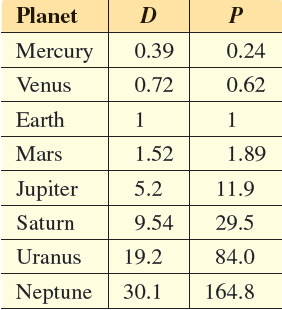
Planet Mercury 0.39 0.24 0.62 Venus 0.72 Earth Mars 1.52 1.89 Jupiter 5.2 11.9 Saturn 9.54 29.5 Uranus 19.2 84.0 164.8 Neptune 30.1
Step by Step Solution
3.57 Rating (164 Votes )
There are 3 Steps involved in it
a In L 1 and L 2 enter the natural D and P respectively If we let x ln D and y ln P the... View full answer

Get step-by-step solutions from verified subject matter experts
 Study Help