



Question: Show a motion diagram. For each of these problems, write a one or two sentence story about a real objec1 that has this motion diagram.
Show a motion diagram. For each of these problems, write a one or two sentence "story" about a real objec1 that has this motion diagram. Your stories should talk about people or objects by name and say what they are doing. Problems 39 through 45 are examples of motion short stories.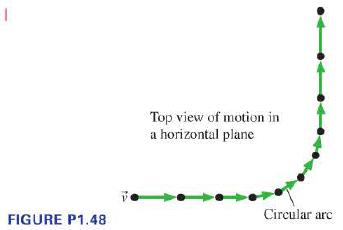
Problem 39 Through 45
39; In a typical greyhound race, a dog accelerates to a speed of 20 m/s over a distance of 30 m. It then maintains this speed.
What would be a greyhound's time in the 100 m dash?
Problem are motion problems similar to those you will learn to solve in Chapter 2. For now, simply interpret the problem by drawing a motion diagram showing the object's position and its velocity vectors. Do not solve these problems or do any mathematics.
40; Billy drops a watermelon from the top of a three-story building, 10 m above the sidewalk. How fast is the watermelon going when it hits?
Problem are motion problems similar to those you will learn to solve in Chapter 2. For now, simply interpret the problem by drawing a motion diagram showing the object's position and its velocity vectors. Do not solve these problems or do any mathematics.
41; Sam is recklessly driving 60 mph in a 30 mph speed zone when he suddenly sees the police. He steps on the brakes and slows to 30 mph in three seconds, looking nonchalant as he passes the officer. How far does he travel while braking?
Problem are motion problems similar to those you will learn to solve in Chapter 2. For now, simply interpret the problem by drawing a motion diagram showing the object's position and its velocity vectors. Do not solve these problems or do any mathematics.
42; A speed skater moving across frictionless ice al 8.0 m/s hits a 5.0-m-wide patch of rough ice. She slows steadily, then continues on at 6.0 m/s. What is her acceleration on the rough ice?
Problem are motion problems similar to those you will learn to solve in Chapter 2. For now, simply interpret the problem by drawing a motion diagram showing the object's position and its velocity vectors. Do not solve these problems or do any mathematics.
43; The giant e land, an African antelope, is an exceptional jumper, able to leap 1.5 m off the ground. To jump this high, with what speed must the eland leave the ground?
Problem are motion problems similar to those you will learn to solve in Chapter 2. For now, simply interpret the problem by drawing a motion diagram showing the object's position and its velocity vectors. Do not solve these problems or do any mathematics.
44; A ball rolls along a smooth horizontal floor at I 0 m/s, then starts up a 20° ramp. How high does it go before rolling back down?
Problem are motion problems similar to those you will learn to solve in Chapter 2. For now, simply interpret the problem by drawing a motion diagram showing the object's position and its velocity vectors. Do not solve these problems or do any mathematics.
45; A motorist is traveling at 20 m/s. J{e is 60 m from a stop light when he sees it turn yellow. His reaction time, before stepping on the brake, is 0.50 s. What steady deceleration while braking will bring him to a stop right at the light?
Problem are motion problems similar to those you will learn to solve in Chapter 2. For now, simply interpret the problem by drawing a motion diagram showing the object's position and its velocity vectors. Do not solve these problems or do any mathematics.
FIGURE P1.48 Top view of motion in a horizontal plane Circular arc
Step by Step Solution
3.38 Rating (148 Votes )
There are 3 Steps involved in it

Get step-by-step solutions from verified subject matter experts