







Question: The air is less dense at higher elevations, so skydivers reach a high terminal speed. The highest recorded speed for a skydiver was achieved in
The air is less dense at higher elevations, so skydivers reach a high terminal speed. The highest recorded speed for a skydiver was achieved in a jump from a height of \(39,000 \mathrm{~m}\). At this elevation, the density of the air is only \(4.3 \%\) of the surface density. Use the data from Example 5.14 to estimate the terminal speed of a skydiver at this elevation.
Example 5.14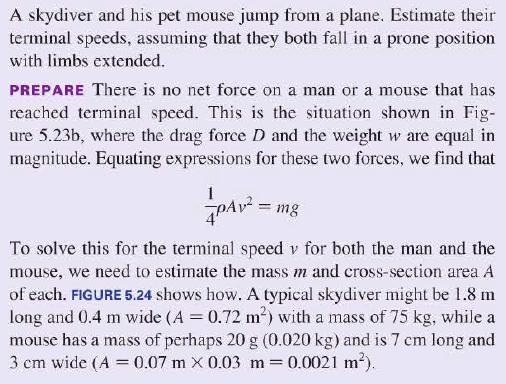
A skydiver and his pet mouse jump from a plane. Estimate their terminal speeds, assuming that they both fall in a prone position with limbs extended. PREPARE There is no net force on a man or a mouse that has reached terminal speed. This is the situation shown in Fig- ure 5.23b, where the drag force D and the weight w are equal in magnitude. Equating expressions for these two forces, we find that 1 PAv = mg To solve this for the terminal speed v for both the man and the mouse, we need to estimate the mass m and cross-section area A of each. FIGURE 5.24 shows how. A typical skydiver might be 1.8 m long and 0.4 m wide (A = 0.72 m) with a mass of 75 kg, while a mouse has a mass of perhaps 20 g (0.020 kg) and is 7 cm long and 3 cm wide (A = 0.07 m x 0.03 m = 0.0021 m).
Step by Step Solution
3.31 Rating (148 Votes )
There are 3 Steps involved in it

Get step-by-step solutions from verified subject matter experts
 Study Help