







Question: Assume an ISP uses three leaky buckets to regulate data received from three customers for transmitting to the Internet. The customers send fixed-size packets (cells).
Assume an ISP uses three leaky buckets to regulate data received from three customers for transmitting to the Internet. The customers send fixed-size packets (cells). The ISP sends 10 cells per second for each customer and the maximum burst size of 20 cells per second. Each leaky bucket is implemented as a FIFO queue (of size 20) and a timer that extracts one cell from the queue and sends it every 1/10 of a second.
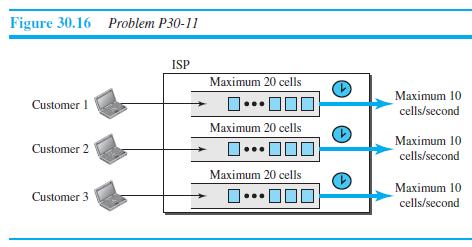
a. Show the customer rate and the contents of the queue for the first customer, which sends 5 cells per second for the first 7 seconds and 15 cells per second for the next 9 seconds.
b. Do the same for the second customer, which sends 15 cells per second for the first 4 seconds and 5 cells per second for the next 14 seconds.
c. Do the same for the third customer, which sends no cells for the first two seconds, 20 cells for the next two seconds, and repeats the pattern four times.
Figure 30.16 Problem P30-11 ISP Maximum 20 cells Maximum 10 Customer I cells/second Maximum 20 cells Maximum 10 cells/second Customer 2 Maximum 20 cells 1. Maximum 10 Customer 3 cells/second
Step by Step Solution
3.47 Rating (176 Votes )
There are 3 Steps involved in it
To better understand the behavior of the leaky bucket in this problem we first create a table in each case to show the movement of cells in the system ... View full answer

Get step-by-step solutions from verified subject matter experts
 Study Help