







Question: Change the floating-point arithmetic algorithms in Sec. 10-5 from binary to decimal data. In a table, list how each microoperation symbol should be interpreted. 10-5
Change the floating-point arithmetic algorithms in Sec. 10-5 from binary to decimal data. In a table, list how each microoperation symbol should be interpreted.
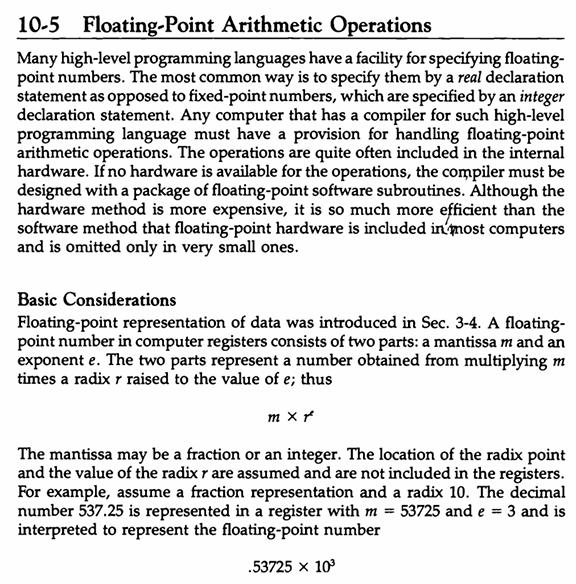
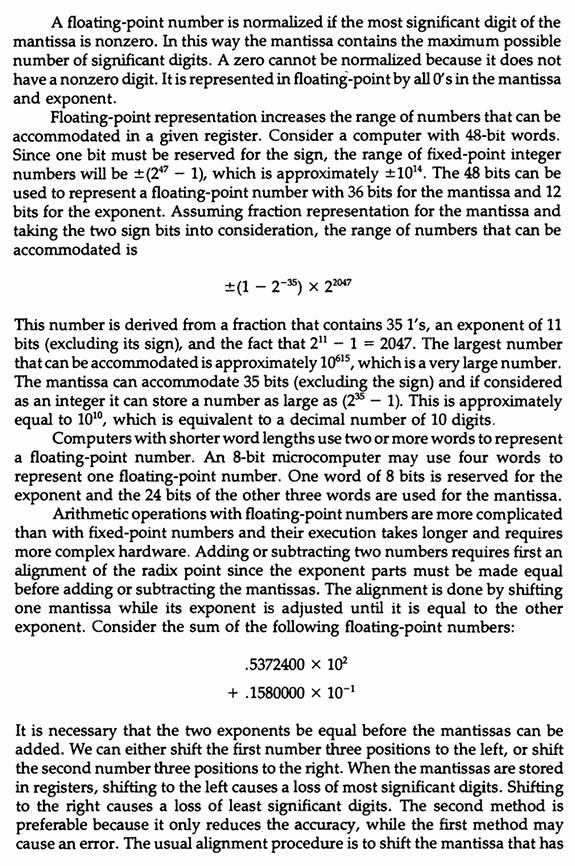
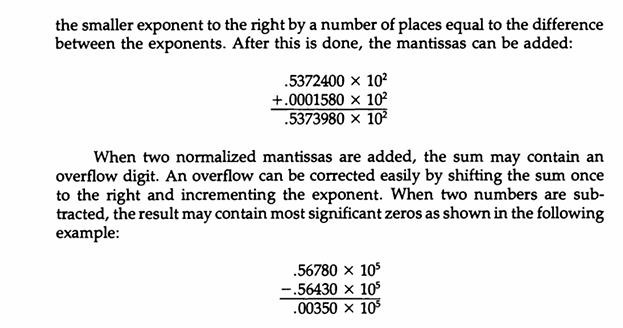
10-5 Floating-Point Arithmetic Operations Many high-level programming languages have a facility for specifying floating- point numbers. The most common way is to specify them by a real declaration statement as opposed to fixed-point numbers, which are specified by an integer declaration statement. Any computer that has a compiler for such high-level programming language must have a provision for handling floating-point arithmetic operations. The operations are quite often included in the internal hardware. If no hardware is available for the operations, the compiler must be designed with a package of floating-point software subroutines. Although the hardware method is more expensive, it is so much more efficient than the software method that floating-point hardware is included in most computers and is omitted only in very small ones. Basic Considerations Floating-point representation of data was introduced in Sec. 3-4. A floating- point number in computer registers consists of two parts: a mantissa m and an exponent e. The two parts represent a number obtained from multiplying m times a radix r raised to the value of e; thus mx r The mantissa may be a fraction or an integer. The location of the radix point and the value of the radix r are assumed and are not included in the registers. For example, assume a fraction representation and a radix 10. The decimal number 537.25 is represented in a register with m = 53725 and e = 3 and is interpreted to represent the floating-point number .53725 10
Step by Step Solution
3.54 Rating (144 Votes )
There are 3 Steps involved in it

Get step-by-step solutions from verified subject matter experts
 Study Help