







Question: Suppose we truncate a 4-bit value (represented by hex digits 0 through F) to a 3 bit value (represented as hex digits 0 through 7.)
Suppose we truncate a 4-bit value (represented by hex digits 0 through F) to a 3 bit value (represented as hex digits 0 through 7.) Fill in the table below showing the effect of this truncation for some cases, in terms of the unsigned and two's complement interpretations of those bit patterns.
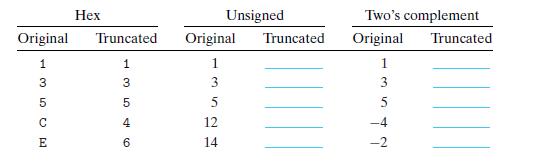
Explain how Equations 2.9 and 2.10 apply to these cases.
Eq. 2.9

Eq. 2.10

Original 1 3 5 E Hex Truncated 1 3 5 4 6 Unsigned Original 1 3 5 12 14 Truncated Two's complement Original Truncated 1 3 5
Step by Step Solution
3.36 Rating (165 Votes )
There are 3 Steps involved in it
The effect of truncation is fairly intuitive for unsigned numbers but not for ... View full answer

Get step-by-step solutions from verified subject matter experts
 Study Help