







Question: In this problem, temperature is held constant but humidity varies. Use Table 25.1 to find water-vapor capacity, and then use the formula for relative humidity
In this problem, temperature is held constant but humidity varies. Use Table 25.1 to find water-vapor capacity, and then use the formula for relative humidity to complete the following chart. What happens to relative humidity when water vapor is added? What happens when water vapor is removed?
Relative humidity = humidity/capacity × 100,
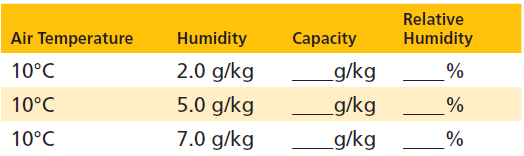
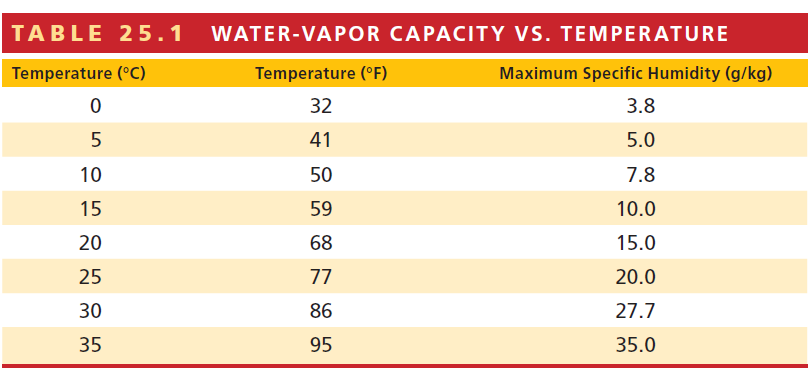
Relative Air Temperature Humidity Humidity Capacity 2.0 g/kg g/kg 10C 5.0 g/kg g/kg 10C 7.0 g/kg g/kg 10C TABLE 25.1 WATER-VAPOR CAPACITY VS. TEMPERATURE Temperature (C) Temperature (F) Maximum Specific Humidity (g/kg) 32 3.8 5 41 5.0 50 7.8 15 59 10.0 20 68 15.0 25 77 20.0 30 86 27.7 35 95 35.0
Step by Step Solution
3.45 Rating (155 Votes )
There are 3 Steps involved in it
Relative humidity HumidityCapacity 100 Air Temperature Humidity Capacity ... View full answer

Get step-by-step solutions from verified subject matter experts
 Study Help