New Semester
Started
Get
50% OFF
Study Help!
--h --m --s
Claim Now
Question Answers
Textbooks
Find textbooks, questions and answers
Oops, something went wrong!
Change your search query and then try again
S
Books
FREE
Study Help
Expert Questions
Accounting
General Management
Mathematics
Finance
Organizational Behaviour
Law
Physics
Operating System
Management Leadership
Sociology
Programming
Marketing
Database
Computer Network
Economics
Textbooks Solutions
Accounting
Managerial Accounting
Management Leadership
Cost Accounting
Statistics
Business Law
Corporate Finance
Finance
Economics
Auditing
Tutors
Online Tutors
Find a Tutor
Hire a Tutor
Become a Tutor
AI Tutor
AI Study Planner
NEW
Sell Books
Search
Search
Sign In
Register
study help
business
management accounting
Management Accounting 5th Edition Don R Hansen, Maryanne M Mowen - Solutions
Discuss the disadvantages of negotiated transfer prices. lop6
Identify three cost-based transfer prices. What are the disadvantages of cost-based transfer prices? When might it be appropriate to use cost-based transfer prices? lop6
The performance of the divisional manager is equivalent to the performance of a division. Do you agree? Explain. lop6
What type of control is being exercised with the use of standards? lop5
Discuss the importance of unit costs. lop5
Describe functional-based costing approaches. lop5
Explain why functional-based costing approaches may produce distorted costs. lop5
Explain how an activity-based costing system works. lop5
Provide a detailed description of how activities can be grouped into homogeneous sets to reduce the number of activity rates. lop5
Describe the role of activity-based costing for organizations with only one product, homogeneous products, or a JIT structure. lop5
What are product costs? lop5
What role do product costs play in bids? lop5
If product costing is the root of the bidding difficulties, why are the smaller, less diverse firms having more success? lop5
Why wasn’t the controller’s office able to explain the highprofit margins on the lowvolume products? lop5
What is meant by a traditional, functional-based costing system? Why might it cause distortions in product costs? lop5
Assuming Sharp’s problems are founded in the way costs are assigned to products, what can Sharp do to solve the problem? lop5
Explain why knowing the unit cost of a product or service is important. lop5
What is cost measurement? cost assignment? What is the difference between the two? lop5
Explain why an actual overhead rate is rarely t used for product costing. lop5
Describe the two-stage process associated with plantwide overhead rates. lop5
Describe the two-stage process for departmental. lop5
Explain why departmental rates might be chosen over plantwide rates. lop5
Explain how low-volume products can be under- costed and high-volume products overcosted if only unit-based cost drivers are used to assign overhead costs. lop5
Explain how undercosting low-volume products and overcosting high-volume products can affect the competitive position of a firm. lop5
What are nonunit-level overhead activities? nonunit-based cost drivers? Give some examples. lop5
What is meant by "product diversity"? lop5
What is an overhead consumption ratio? lop5
Explain how departmental overhead rates can produce product costs that are more distorted than those computed using a plantwide rate. produced. Why are they produced? lop5
Overhead costs are the source of product cost dis- tortions. Do you agree? Explain. lop5
What is activity-based product costing? lop5
What is an activity dictionary? lop5
What is the difference between a primary and a secondary activity? lop5
Explain how costs are assigned to activities. lop5
Explain how homogeneous sets of activities are overhead rates. lop5
What is a homogeneous cost pool? lop5
What are unit-level activities? batch-level activities? product-level activities? facility-level activities? lop5
What is JIT manufacturing? List five ways in which JIT manufacturing differs from traditional manufacturing? lop5
What are manufacturing cells? Explain how they differ from production departments. lop5
Explain why some indirect manufacturing costs i in traditional manufacturing become direct costs in JIT manufacturing Give some examples of costs that change in this way. lop5
In JIT manufacturing, direct labor costs are less important and largely fixed in nature. Do you agree? Explain. lop5
Without inventories, there is no distinction between product and period costs. Do you agree? Explain. lop5
How does JIT manufacturing increase product- costing accuracy? lop5
Why might ABC be useful in a company with only one product? with JIT manufacturing? lop5
Nublado Company produces ski boots. At the beginning of the year, the cost manager estimated that overhead costs would be $2,910,000 and that the units produced would be 300,000. Actual data concerning production for the past year follow:Brooks Manufacturing uses a normal costing system. Budgeted
Compute the predetermined overhead rate for Brooks Manufacturing. lop5
Compute the applied overhead.lop5
Compute the overhead variance and label the variance as underapplied or overapplied overhead.lop5
Explain why predetermined rates are used.lop5
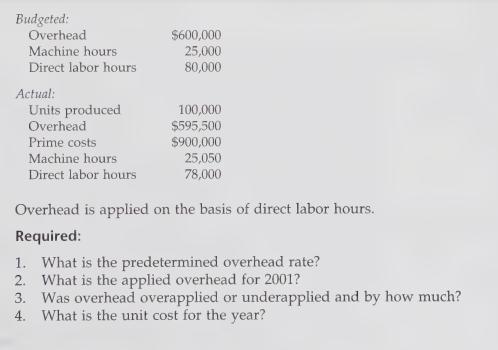
Morris Systems Design develops specialized software for companies and uses a normal costing system. The following data are available for 2001: lop5 Budgeted: Overhead $600,000 Machine hours 25,000 Direct labor hours 80,000 Actual: Units produced 100,000 Overhead $595,500 Prime costs $900,000
Using the information from Exercise 4-3, suppose Morris Systems Design applied overhead to production on the basis of machine hours instead of direct labor hours.Required:What is the predetermined overhead rate?What is the applied overhead for 2001?Is overhead overapplied or underapplied and by how
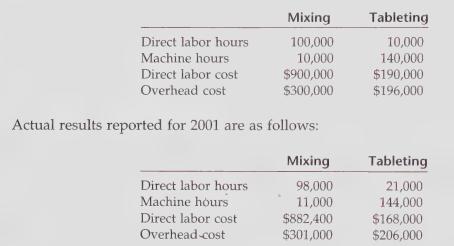
Herbal Vitamex, Inc., uses a predetermined overhead rate to apply overhead.Overhead is applied on the basis of direct labor hours in the mixing department and on the basis of machine hours in the tableting department. At the beginning of 2001, the following estimates are provided for the coming
Compute the predetermined overhead rate for each department. lop52
Compute the applied overhead for the year 2001. What is the underapplied or overapplied overhead for each department? for the firm? lop5
Suppose a batch of tablets used 2,000 direct labor hours in mixing and 800 machine hours in tableting. If the batch size is 40,000 units, what is the overhead cost per tablet? lop5
Plata Company has traditionally produced a handcrafted soft leather briefcase un- der the label Maletin Elegant. Recently the company began producing a second brief- case using lower-quality materials and automation so that it can be produced in larger quantities. This case is sold under the label
A hospital is in the process of implementing an ABC system. A pilot study is being done to assess the effects of the costing changes on specific products. Of particular interest is the cost of caring for patients who receive in-patient recovery treatment for illness, surgery (noncardiac), and
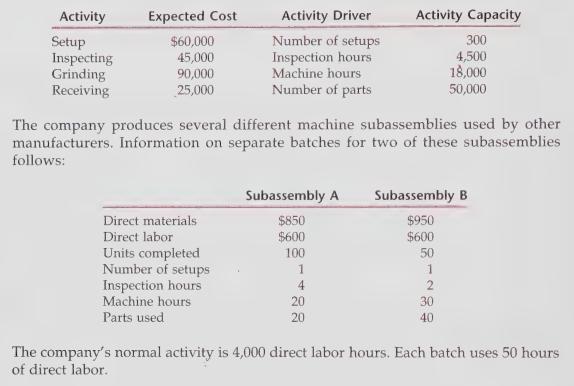
Milan Machining Company has identified the following overhead activities, costs, and activity drivers for the coming year: lop5 Activity Expected Cost Activity Driver Activity Capacity Setup $60,000 Number of setups 300 Inspecting 45,000 Inspection hours 4,500 Grinding 90,000 Machine hours 18,000
Bijan Company uses FIFO to account for the costs of production. For the first pro- cessing department, the following equivalent-unit schedule has been prepared: LO3 Conversion Materials Cost Units started and completed 45,000 45,000 Units in beginning work in process X Fraction to complete: 8,000
Naylor Company has two processing departments: assembly and finishing. A pre- determined overhead rate of $6 per DLH is used to assign overhead to production. The company experienced the following operating activity for November:Raw materials issued to assembly, $15,200.Direct labor cost: assembly,
Describe the basic characteristics and cost flows associated with process manufacturing. LO3
Define equivalent units and explain their role in process costing. Explain the differences between the weighted average method and the FIFO method of accounting for process costs. LO3
Prepare a departmental production report using the weighted average method. LO3
Explain how process costing is affected by nonuniform application of manufacturing inputs and the existence of multiple processing departments. LO3
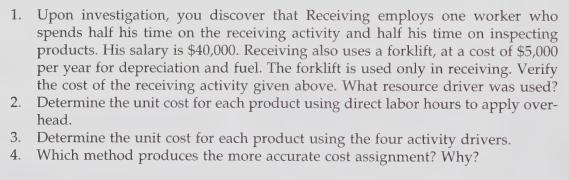
Prepare a departmental production report using the FIFO method. (Appendix)1. Why do you suppose that Makenzie did not originally implement an accounting system that would give individual product costs?2. Using a separate work-inprocess account for each producing department, describe the flow of
Distinguish between sequential processing and parallel processing. LO3
Describe the differences between process costing and job-order costing. LO3
What are equivalent units? Why are they needed in a process costing system? LO3
Under what conditions will the weighted average and FIFO methods give essentially the same re- sults? LO3
Explain why transferred-in costs are a special type of raw material for the receiving department. LO3
What are the similarities in and differences be- tween the manufacturing cost flows for job-order firms and process firms? LO3
Describe the five steps in accounting for the man- ufacturing activity of a processing department and explain how they interrelate. LO3
What is a production report? What purpose does this report serve? LO3
In assigning costs to goods transferred out, how do the weighted average and FIFO methods differ? LO3
Describe the effect of automation on the process accounting system. LO3
How does the adoption of a JIT (just-in-time) ap- proach to manufacturing affect process costing? LO3
How would process costing for services differ from process costing for manufactured goods? LO3
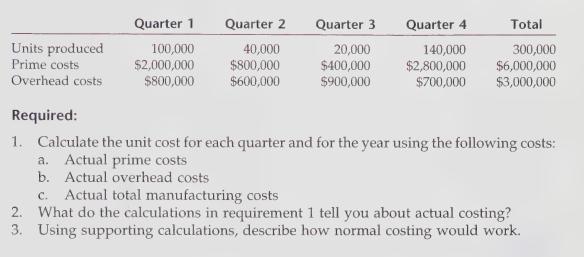
Jumpin Jeans produces a variety of styles of jeans in three departments: cutting, sewing, and packaging. During the month, the three departments recorded the following costs: LO3 Required:1. Prepare a schedule showing, for each department, the cost of direct materials, direct labor, applied
Department B had the following data for November: LO3 Units in beginning work in process Units completed Units in ending work in process (30% complete) Total manufacturing cost Required: 500 300 $1,652 1. Calculate equivalent units of production in ending work-in-process inventory. Calculate
Department B had the following data for November: LO3 Units in beginning work in process Units completed Units in ending work in process (30% complete) Total manufacturing cost Required: 500 300 $1,652 1. Calculate equivalent units of production in ending work-in-process inventory. Calculate
Lau Company manufactures a product that passes through two processes. The fol- lowing information was obtained for the first department for May: LO3 a. All materials are added at the beginning of the process.b. Beginning work in process had 9,000 units, 30 percent complete with respect to
Sensaround, Inc., manufactures products that pass through two or more processes. Sensaround uses the weighted average method to compute unit costs. During April, equivalent units were computed as follows: LO3 The unit cost was computed as follows:Materials $1.30 Conversion cost 0.50 Total $1.80
Shannon Company produces a product that passes through two departments.Data for June on Department 1 included: beginning work in process was zero;ending work in process had 300 units, 50 percent complete with respect to conversion costs; and 540 units were started. Materials are added at the
Palomino, Inc., manufactures a variety of paints in three departments: grinding, mixing, and canning. Palomino uses the weighted average method. The following are cost and production data for the grinding department for March (assume that units are measured in pounds): LO3 Production:Units in
Refer to Exercise 6-6. Prepare a cost of production report for the grinding department for the month of March. LO3
Gilroy, Inc., produces key chains. The key chains are produced in two departments. LO3 The data for Department 1 are as follows:Beginning work in process =Units started 43,000 Units transferred out 33,500 Raw materials cost $16,340 Direct labor cost $27,126 Overhead applied $63,294.Materials are
Kirlen Company manufactures soluble plant fertilizer. Department 1 mixes the chemicals required for the fertilizer. The following data are for the year: LO3 Beginning work in process =Units started 92,500 Raw materials cost $277,500 Direct labor cost $50,680 Overhead applied $76,020 Units in
The following data are for four independent process costing departments. LO3 an A B a C D Beginning inventory 3,200 1,000 0 30,000 Percent completion 30% 40% 0% 75% Units started 17,000 23,000 40,000 40,000 Ending inventory 4,000 0 9,000 10,000 Percent completion 25% 0% 10% 25%Required:Compute the
Using the data from Exercise 6-10, compute the equivalent units of production for each of the four departments using the FIFO method. LO3
Terry Linens, Inc., manufactures bed and bath linens. The bath linens department sews terry cloth into towels of various sizes. Terry uses the weighted average Nonuniform Input: eke method. All materials are added at the beginning of the process. The following data are for the bath linens
Refer to Exercise 6-12. Prepare a cost of production report for the bath linens deeeteaeProdicton partment for August using the weighted average method. LO3
Drysdale Dairy produces a variety of dairy products. In Department 12, cream (transferred in from Department 6) and other materials (sugar and flavorings) are mixed and churned to make ice cream. The following data are for Department 12 for August: LO3 Production:Units in process, August 1, 25%
Halligan Company manufactures a product in four departments. Data for the first department follow:Production:Units in process, July 1, 75% complete 60,000 Units completed and transferred out 150,000 Units in process, July 31, 25% complete 30,000 Costs:Work in process, July 1 $193,500 Costs added
Refer to Exercise 6-15. Prepare a cost of production report for the first department of Halligan Company for the month of July. LO3
Rafer to the data in Exercise 6-17. Compute the cost of ending work in process and the cost of goods transferred out using the weighted average method. LO3
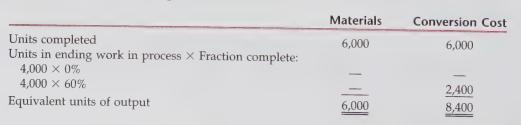
Poston Products, Inc., produces a chemical product that passes through three departments. For May, the following equivalent-unit schedule was prepared for the first department: LO3 Materials Conversion Cost Units completed 5,000 5,000 Units in ending work in process < Fraction complete:6,000 X
Tolliver Company is a manufacturer that uses FIFO to account for its production costs. The product Tolliver makes passes through two processes. Tolliver’s controller prepared the following equivalent-unit schedule:Conversion Materials Cost Units started and completed 8,000 8,000 Units in
Hogarth, Inc., manufactures a product that passes through three processes. During July, the first department transferred 12,000 units to the second department. The cost of the units transferred into the second department was $25,200. Materials are added uniformly in the second process.The second
Using the same data found in Exercise 6-21, assume the company uses the FIFO method.Required:Prepare a schedule of equivalent units and compute the unit cost for July. LO3
Wholesome Bread makes and supplies bread throughout the western United States.Six operations describe the production process.a. Flour, milk, yeast, salt, butter, and so on are mixed ina large vat.b. A conveyor belt transfers the dough to a machine that weighs it and shapes it into loaves.The
Funnifaces, Inc., manufactures various Halloween masks. Each mask is shaped from a piece of rubber in the molding department. The masks are then transferred to the finishing department where they are painted and have elastic bands attached. In April, the molding department reported the following
Showing 1900 - 2000
of 5025
First
13
14
15
16
17
18
19
20
21
22
23
24
25
26
27
Last
Step by Step Answers

 Get 50% OFF
Claim Now
Get 50% OFF
Claim Now