







Question: Section 4.2.2 describes a method for generating association rules from frequent itemsets. Propose a more efficient method. Explain why it is more efficient than the
Section 4.2.2 describes a method for generating association rules from frequent itemsets. Propose a more efficient method. Explain why it is more efficient than the one proposed there. (consider incorporating the properties of Exercises 4.3(b), (c) into your design.)
Section 4.2.2
Exercises 4.3
b. Prove that the support of any nonempty subset \(s^{\prime}\) of itemset \(s\) must be at least as great as the support of \(s\).
c. Given frequent itemset \(l\) and subset \(s\) of \(l\), prove that the confidence of the rule " \(s\) ' \(\Rightarrow\) \(\left(l-s^{\prime}ight)\) " cannot be more than the confidence of " \(s \Rightarrow(l-s)\)," where \(s^{\prime}\) is a subset of \(s\).
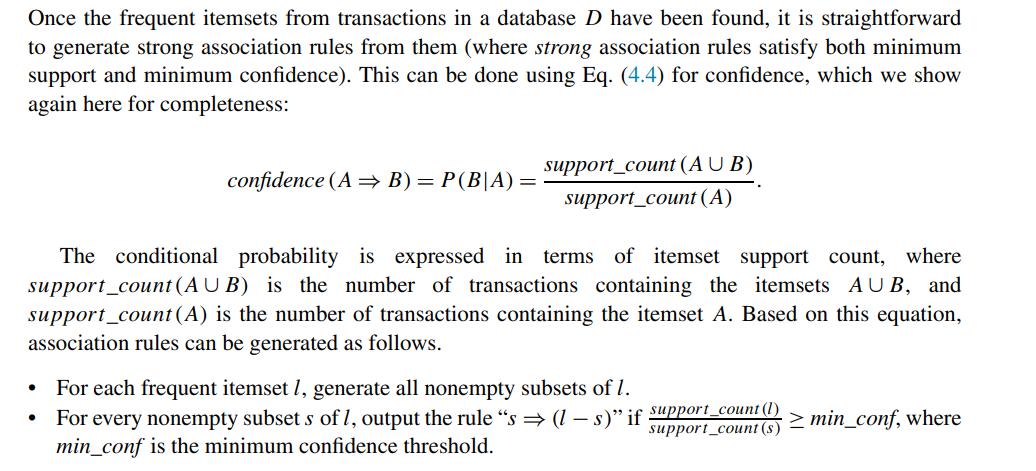
Once the frequent itemsets from transactions in a database D have been found, it is straightforward to generate strong association rules from them (where strong association rules satisfy both minimum support and minimum confidence). This can be done using Eq. (4.4) for confidence, which we show again here for completeness: confidence (A B)=P(B|A) = support_count (AUB) support_count (A) The conditional probability is expressed in terms of itemset support count, where support_count (AUB) is the number of transactions containing the itemsets AUB, and support_count (A) is the number of transactions containing the itemset A. Based on this equation, association rules can be generated as follows. For each frequent itemset 1, generate all nonempty subsets of 1. For every nonempty subset s of 1, output the rule "s (1-s)" if support_count (1) min_conf is the minimum confidence threshold. support_count (s) min_conf, where
Step by Step Solution
3.31 Rating (151 Votes )
There are 3 Steps involved in it
The provided section 422 explains a method to generate association rules from frequent itemsets which rely on the calculation of confidence for each p... View full answer

Get step-by-step solutions from verified subject matter experts
 Study Help