







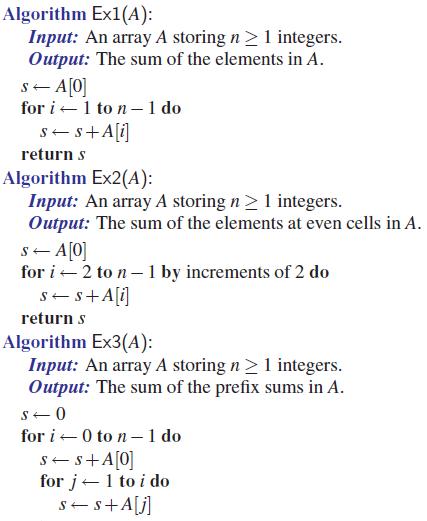
Question: Show that if d(n) is O( (n)) and e(n) is O(g(n)), then d(n) +e(n) is O( (n)+g(n)). Algorithm Ex1(A): Input: An array A
Show that if d(n) is O( ∫ (n)) and e(n) is O(g(n)), then d(n) +e(n) is O( ∫ (n)+g(n)).
![sum of the elements in A. S A[0] for i 1 to](https://dsd5zvtm8ll6.cloudfront.net/si.question.images/images/question_images/1664/4/4/7/80963357541e186a1664447808980.jpg)
Algorithm Ex1(A): Input: An array A storing n 1 integers. Output: The sum of the elements in A. S A[0] for i 1 to n - 1 do s+s+A[i] return s Algorithm Ex2(A): Input: An array A storing n> 1 integers. Output: The sum of the elements at even cells in A. S A[0] for i 2 to n-1 by increments of 2 do s+s+A[i] return s Algorithm Ex3(A): Input: An array A storing n 1 integers. Output: The sum of the prefix sums in A. -0 S for i 0 to n-1 do s+S+A[0] for j1 to i do s+s+A[j]
Step by Step Solution
3.40 Rating (147 Votes )
There are 3 Steps involved in it
Solution We can do this because dn en is defined from 0 through n Also in the special c... View full answer

Get step-by-step solutions from verified subject matter experts
 Study Help