







Question: Exercise 6.20 introduced a linear model for predicting relative orange area from proportion of loci that are heterozygous (MLH). Relative orange area refers to the
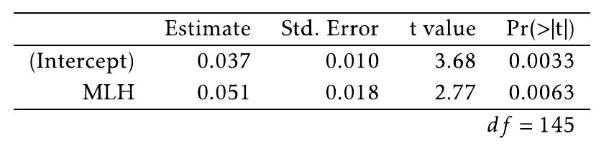
Exercise 6.20 introduced a linear model for predicting relative orange area from proportion of loci that are heterozygous (MLH). Relative orange area refers to the percentage of the body that is orange (rather than a different color).
(a) Write the estimated model equation.
(b) What is the predicted mean relative orange area for a guppy that is heterozygous at 8 out of 9 loci?
(c) Based on the linear model, how much does mean relative orange area differ between a guppy that is heterozygous at 2 loci versus 4 loci (out of 9 total)?
(d) Conduct a hypothesis test to determine whether relative orange area is significantly associated with MLH. Do the results suggest that more elaborate sexual ornaments are associated with increased heterozygosity? Explain.
(e) Compute and interpret a \(95 \%\) confidence interval for the slope parameter \(\beta_{1}\).
Data From Exercise 6.20
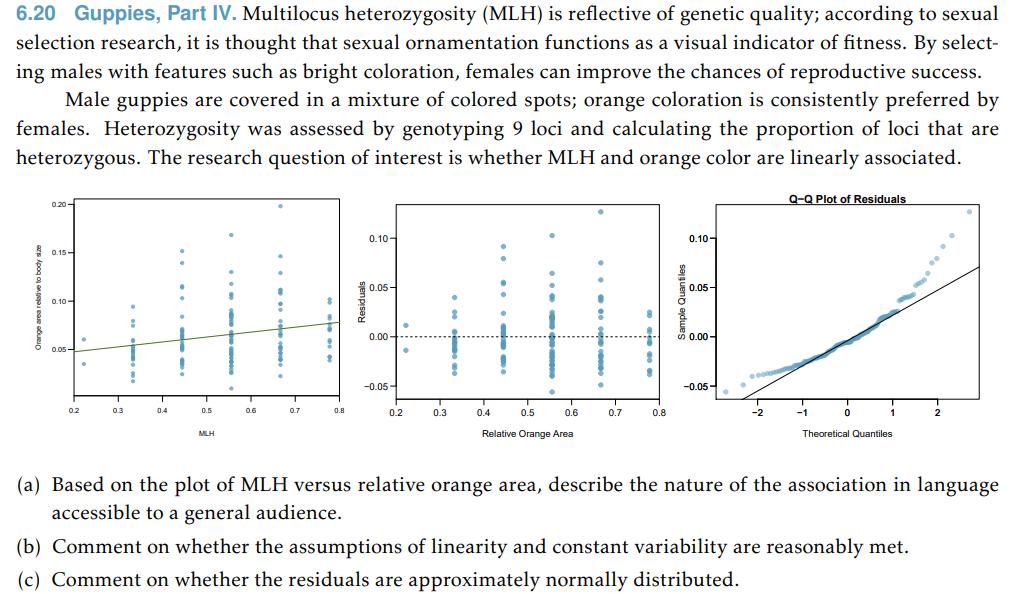
Estimate Std. Error t value Pr(>|t|) (Intercept) 0.037 0.010 3.68 0.0033 MLH 0.051 0.018 2.77 0.0063 df = 145
Step by Step Solution
There are 3 Steps involved in it

Get step-by-step solutions from verified subject matter experts
 Study Help