







Question: Repeat Exercise 10.10 using the filter bank whose analysis lowpass and highpass filters are listed in Table 10.4. Compare the results with those obtained in
Repeat Exercise 10.10 using the filter bank whose analysis lowpass and highpass filters are listed in Table 10.4. Compare the results with those obtained in Exercise
10.10 for the same quantization step sizes.
Exercise 10.10
Repeat Exercise 10.9, this time using as input the image cameraman. tif from the MATLAB Image Processing Toolbox. Observe how the increase in the quantization step sizes affects the reconstructed image quality.
Exercise 10.9,
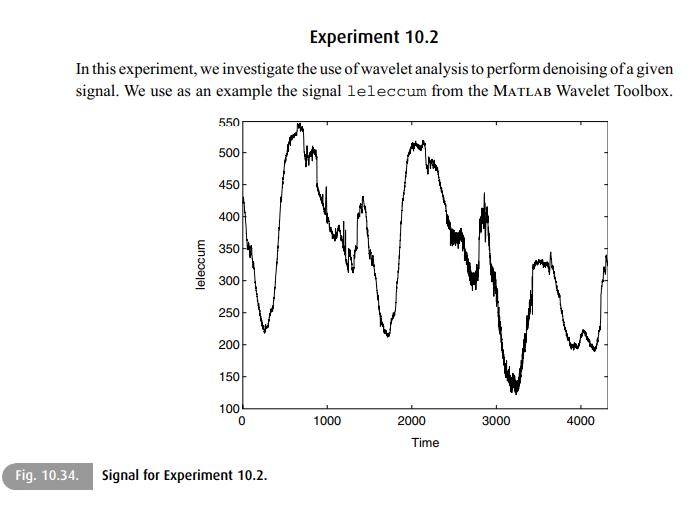
Quantization of wavelet transforms: use the signal generated in Experiment 10.1 and compute its \(N\)-stage wavelet transform with both the bior 4.4 and the \(\mathrm{db} 4\) wavelets. Use \(N=3, N=6\), and \(N=8\). Quantize its coefficients using several quantization step sizes \(q\). Use for the quantized value of \(\mathrm{x}\) the function \(q^{*}\) round \((x / q)\). Then reconstruct the signal from the quantized lowpass band and detail bands and observe the result. Repeat this exercise for the signal leleccum used in Experiment 10.2.
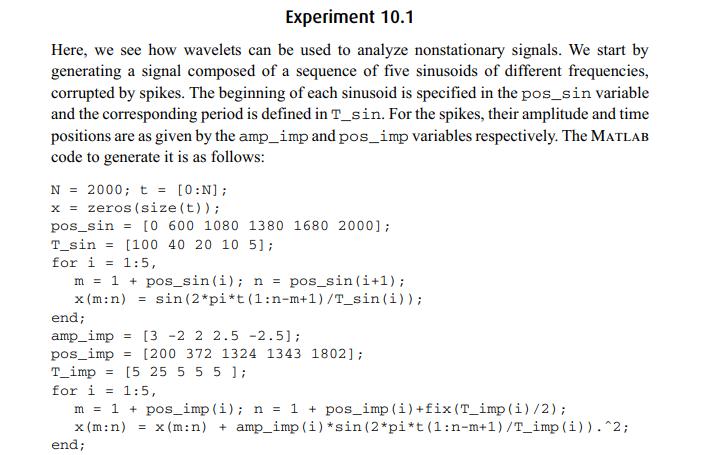
Experiment 10.1 Here, we see how wavelets can be used to analyze nonstationary signals. We start by generating a signal composed of a sequence of five sinusoids of different frequencies, corrupted by spikes. The beginning of each sinusoid is specified in the pos_sin variable and the corresponding period is defined in T_sin. For the spikes, their amplitude and time positions are as given by the amp_imp and pos_imp variables respectively. The MATLAB code to generate it is as follows: N = 2000; t = [0:N]; x = zeros (size (t)); pos sin [0 600 1080 1380 1680 2000]; T_sin [100 40 20 10 5]; for i 1:5, m1+pos_sin(i); n = pos_sin (i+1); x(m:n) = end; sin(2*pi*t (1:n-m+1)/T_sin(i)); amp_imp = [3 2 2 2.5 -2.5]; pos imp [200 372 1324 1343 1802]; Timp [5 25 5 5 5 ]; for i 1:5, m 1 + pos_imp (i); n = 1 + pos_imp (i)+fix (T_imp (i)/2); x (m:n) = x (m:n) amp_imp (i) *sin(2*pi*t (1:n-m+1)/T_imp (i)). ^2; end;
Step by Step Solution
3.45 Rating (165 Votes )
There are 3 Steps involved in it

Get step-by-step solutions from verified subject matter experts
 Study Help