







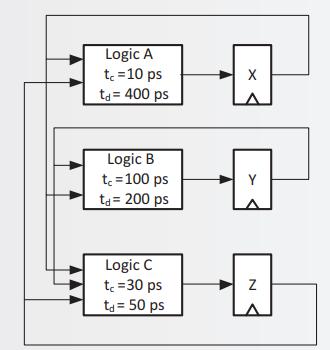
Question: Repeat Exercise 15.22, instead using flip-flop specification B and a 2 ns clock. Data in Exercise 15.22, Calculate the maximum allowable clock skew in Figure
Repeat Exercise 15.22, instead using flip-flop specification B and a 2 ns clock.
Data in Exercise 15.22,
Calculate the maximum allowable clock skew in Figure 15.19. Indicate between which pair of flip-flops the skew occurs and whether it will trigger a setup or hold violation. Use flip-flop specification A and a 2 ns clock. You may want to enumerate all possible paths and write the setup and hold equations.
Data in Figure 15.19.
Step by Step Solution
★★★★★
3.39 Rating (165 Votes )
There are 3 Steps involved in it
1 Expert Approved Answer
Step: 1 Unlock

Using flipflop specification B and a 2 ns clock the maximum allowable clock skew can be calculated b... View full answer
Question Has Been Solved by an Expert!
Get step-by-step solutions from verified subject matter experts
Step: 2 Unlock
Step: 3 Unlock
 Study Help