



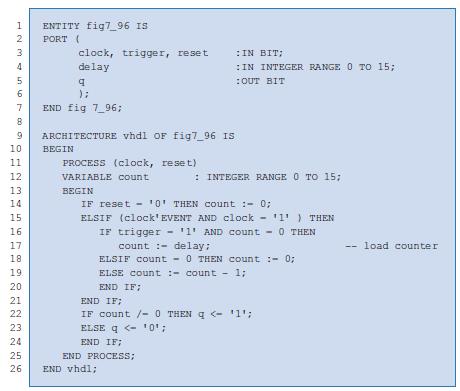
Question: Use Alteras simulator to test the nonretriggerable, level-sensitive, one-shot design example in either Figure 7-95 (AHDL) or 7-96 (VHDL). Use a 1-kHz clock and create
Use Altera’s simulator to test the nonretriggerable, level-sensitive, one-shot design example in either Figure 7-95 (AHDL) or 7-96 (VHDL). Use a 1-kHz clock and create a 10-ms output pulse for the simulation. Verify that:
(a) The correct pulse width is created when triggered.
(b) The output can be terminated early with the reset input.
(c) The one-shot design is nonretriggerable and cannot be triggered again until it has timed out.
(d) The trigger signal must last long enough for the clock to catch it.
(e) The pulse width can be changed to a different value.
Figure 7-95
![12345 6 7 8 9 SUBDESIGN fig7_95 ( ) clock, trigger, reset delay [3..0] q VARIABLE count [3..0] BEGIN 10 11 12](https://dsd5zvtm8ll6.cloudfront.net/images/question_images/1699/9/6/3/7886553638c8cef91699963788806.jpg)
Figure 7-96
12345 6 7 8 9 SUBDESIGN fig7_95 ( ) clock, trigger, reset delay [3..0] q VARIABLE count [3..0] BEGIN 10 11 12 13. 14 15 16 17 18 END; : DFF; count[].clk - clock; count[].clrn - reset; IF trigger & count [].qb"0000" THEN count[].d delay []; : INPUT; : INPUT; : OUTPUT: ELSIF count[].qB"0000" THEN count[].d - B"0000"; ELSE count[].d count[].q- 1; END IF; q count[].q - B"0000"; -- make output pulse
Step by Step Solution
3.46 Rating (172 Votes )
There are 3 Steps involved in it

Get step-by-step solutions from verified subject matter experts