







Question: Frederick Schut and Peter VanBergeijk16 published an article in which they attempted to see if the pharmaceutical industry practiced international price discrimination by estimating a
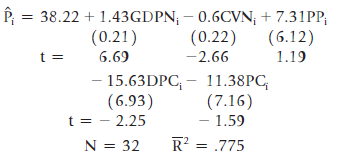
Where:
Pi = the pharmaceutical price level in the ith country divided by that of the United States
GDPNi = per capita domestic product in the ith country divided by that of the United States
CVNi = per capita volume of consumption of pharmaceuticals in the ith country divided by that of the United States
PPi = a dummy variable equal to 1 if patents for pharmaceutical products are recognized in the ith country, 0 otherwise
DPCi = a dummy variable equal to 1 if the ith country applied strict price controls, 0 otherwise
PCi = a dummy variable equal to 1 if the ith country encouraged price competition, 0 otherwise
a. Develop and test appropriate hypotheses concerning the regression coefficients using the t-test at the 5-percent level.
b. Set up 90-percent confidence intervals for each of the estimated slope coefficients.
c. Do you think Schut and VanBergeijk concluded that international price discrimination exists? Why or why not?
d. How would the estimated results have differed if the authors had not divided each country€™s prices, per capita income, and per capita pharmaceutical consumption by that of the United States? Explain your answer.
P = 38.22 + 1.43GDPN; 0.GCVN; + 7.31PP; (6.12) 1.19 (0.21) (0.22) 6.69 -2.66 - 15.63DPC; 11.38PC; (6.93) t = - 2.25 (7.16) - 1.59 R? = .775 N = 32
Step by Step Solution
3.44 Rating (157 Votes )
There are 3 Steps involved in it
a All five tests are onesided so tc 1706 throughout GDPN H 0 0 H A 0 Reject H 0 beca... View full answer

Get step-by-step solutions from verified subject matter experts
Document Format (2 attachments)

1443_6054778c0636d_641450.pdf
180 KBs PDF File

1443_6054778c0636d_641450.docx
120 KBs Word File
 Study Help