







Question: For Example 12.3, verify that the potentials o (z), o (z) given by relations (12.8.14) satisfy the stress-free boundary conditions on the problem.
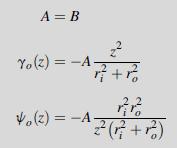
For Example 12.3, verify that the potentials γo(z), Ψo(z) given by relations (12.8.14) satisfy the stress-free boundary conditions on the problem.
Data from example 12.3
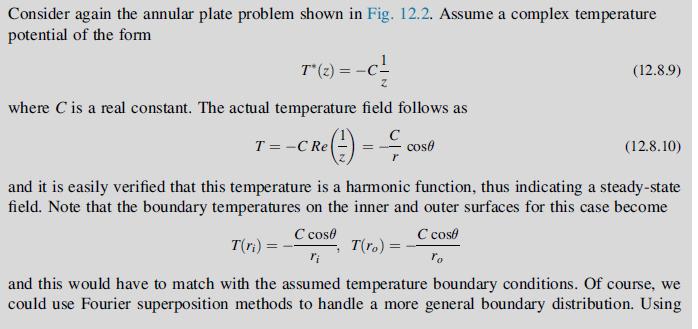
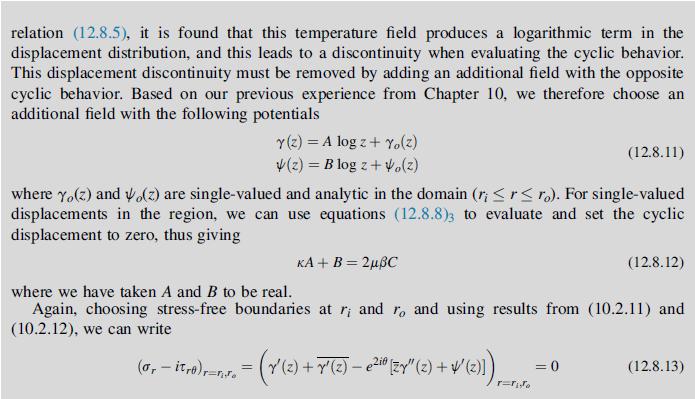
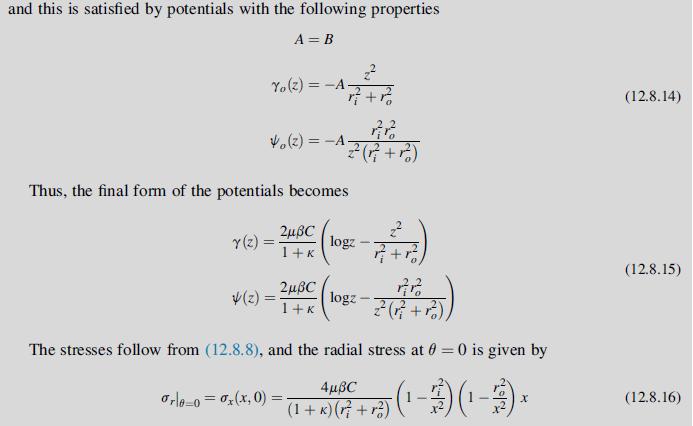
Equation 12.8.14
Consider again the annular plate problem shown in Fig. 12.2. Assume a complex temperature potential of the form T*(2) = -C/ where C is a real constant. The actual temperature field follows as C T=-C Re Re ( 2 ) = = = 2 T(ri) = cose T(ro) = (12.8.9) and it is easily verified that this temperature is a harmonic function, thus indicating a steady-state field. Note that the boundary temperatures on the inner and outer surfaces for this case become C cost C cost To (12.8.10) and this would have to match with the assumed temperature boundary conditions. Of course, we could use Fourier superposition methods to handle a more general boundary distribution. Using
Step by Step Solution
3.46 Rating (149 Votes )
There are 3 Steps involved in it
From relations 128... View full answer

Get step-by-step solutions from verified subject matter experts
 Study Help