







Question: For the isotropic self-consistent crack distribution case in Example 15.12, show that for the case v = 0.5, relation (15.3.4) 3 reduces to: Verify the
For the isotropic self-consistent crack distribution case in Example 15.12, show that for the case v = 0.5, relation (15.3.4)3 reduces to:
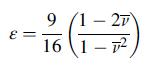
Verify the total loss of moduli at ε = 9/
16. Using these results, develop plots of the effective moduli ratios v̅/v,E̅/
E,µ̄/µ versus the crack density. Compare these results with the corresponding values from the dilute case given in Example 15.10.
Data from example 15.10
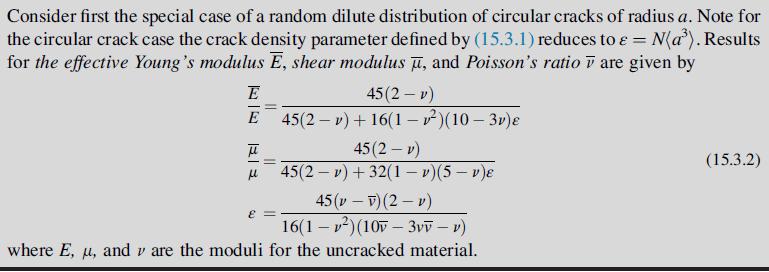
Data from example 15.12
Using the self-consistent method, effective moduli for the random distribution case can be developed. The results for this case are given by:
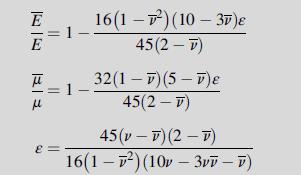
It is interesting to note that as ε→9/16, all effective moduli decrease to zero. This can be interpreted as a critical crack density where the material will lose its coherence. Although it would be expected that such a critical crack density would exist, the accuracy of this particular value is subject to the assumptions of the modeling and is unlikely to match universally with all materials.
Equation 15.3.4
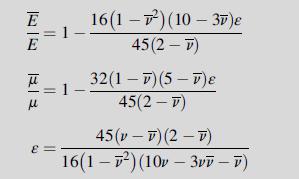
8 = 9 16 - 27 12
Step by Step Solution
3.32 Rating (152 Votes )
There are 3 Steps involved in it
Isotropic Self Consistent Crack Distribution Case with v05 45VV2V 4505V2v 16110v 3vvv 161V515VV 8 by ... View full answer

Get step-by-step solutions from verified subject matter experts
 Study Help