







Question: For the torsion problem in Example 9.3, explicitly justify that the required values for the constants appearing in the stress function are given by c
For the torsion problem in Example 9.3, explicitly justify that the required values for the constants appearing in the stress function are given by c = 3–√8 and K=–μα/
[4a2(1–√2)]. Also calculate the resulting shear stresses and determine the location and value of the maximum stress.
Data from example 9.3
As a final example of the boundary equation scheme, consider the more general case of a section with a polynomial boundary equation. The trial stress function is taken of the form:

and these represent pairs of curves shown in Fig. 9.11 that can be interpreted as bounding a closed region R as shown. This region is taken as the cylinder section for the torsion problem. As before, this stress function vanishes on the boundary, and it satisfies the governing equation (9.3.9) if c = 3–√8 and K =–μα/[4a2(1–√2)]. The stresses and displacements can be calculated using the previous procedures (see Exercise 9.16). Timoshenko and Goodier (1970) discuss additional examples of this type of problem.
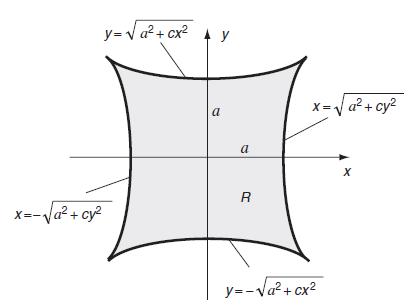
= K (a-x + cy) (a + cx - y) (9.4.19) where K, a, and c are constants to be determined. The terms in parentheses can be rewritten as x = a + cy, y = a + cx
Step by Step Solution
3.39 Rating (171 Votes )
There are 3 Steps involved in it
From Example 93 o Kax cya cx y Differenti al Equati... View full answer

Get step-by-step solutions from verified subject matter experts
 Study Help