







Question: Intelligence Tests a. Use the information in Table 10-4 on page 356 and estimate the standard deviation for adult WAIS-R scores. Use at least two
Intelligence Tests
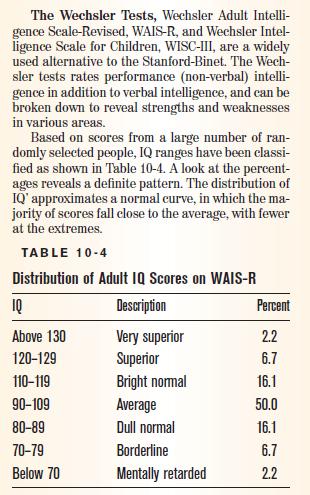
a. Use the information in Table 10-4 on page 356 and estimate the standard deviation for adult WAIS-R scores. Use at least two different pieces of information to obtain two separate estimates.
Determine your answer.
b. Does the IQ score discussed here seem to have a normal distribution? Give reasons to support your answer.
c. What percentage of the adult population has “superior” intelligence?
d. What is the probability of randomly selecting one person from this population who is classified below “average”?
e. What IQ score is at the 95th percentile? Explain what this means.
The Wechsler Tests, Wechsler Adult Intelli- gence Scale-Revised, WAIS-R, and Wechsler Intel- ligence Scale for Children, WISC-III, are a widely used alternative to the Stanford-Binet. The Wech- sler tests rates performance (non-verbal) intelli- gence in addition to verbal intelligence, and can be broken down to reveal strengths and weaknesses in various areas. Based on scores from a large number of ran- domly selected people, IQ ranges have been classi- fied as shown in Table 10-4. A look at the percent- ages reveals a definite pattern. The distribution of IQ' approximates a normal curve, in which the ma- jority of scores fall close to the average, with fewer at the extremes. TABLE 10-4 Distribution of Adult IQ Scores on WAIS-R IQ Description Percent Above 130 Very superior 2.2 120-129 Superior 6.7 110-119 Bright normal 16.1 90-109 Average 50.0 80-89 Dull normal 16.1 70-79 Borderline 6.7 Below 70 Mentally retarded 2.2
Step by Step Solution
There are 3 Steps involved in it

Get step-by-step solutions from verified subject matter experts
 Study Help