New Semester
Started
Get
50% OFF
Study Help!
--h --m --s
Claim Now
Question Answers
Textbooks
Find textbooks, questions and answers
Oops, something went wrong!
Change your search query and then try again
S
Books
FREE
Study Help
Expert Questions
Accounting
General Management
Mathematics
Finance
Organizational Behaviour
Law
Physics
Operating System
Management Leadership
Sociology
Programming
Marketing
Database
Computer Network
Economics
Textbooks Solutions
Accounting
Managerial Accounting
Management Leadership
Cost Accounting
Statistics
Business Law
Corporate Finance
Finance
Economics
Auditing
Tutors
Online Tutors
Find a Tutor
Hire a Tutor
Become a Tutor
AI Tutor
AI Study Planner
NEW
Sell Books
Search
Search
Sign In
Register
study help
engineering
electrical systems for buildings
Energy Efficient Electrical Systems For Buildings 1st Edition Moncef Krarti - Solutions
Consider an MCC with six identical motors, each motor rated at 60 HP, three-phase, 60 Hz, 460 V, 1760 RPM, a service factor of 1.00, and a power factor of 90%. All the motors are protected by time-delay fuses and have full voltage nonreversing starter type.(a) Estimate the efficiency of each motor
Consider an MCC with nine identical motors, each motor rated at 50 HP, three-phase, 60 Hz, 460 V, 1175 RPM, a service factor of 1.00, and a power factor of 90%. All the motors are protected by time-delay fuses and have full voltage non-reversing starter type.(a) Design a branch circuit for one
A motor control center has three induction motors each rated at 40 HP and 480 V and 4 induction motors each rated at 30 HP and 480-V. Each 40-HP motor has an efficiency of 0.92, 1172 rpm, a power factor of 0.85, a nameplate rating of 45 A, a service factor of 1.15, and a FVNR controller. Each 30-HP
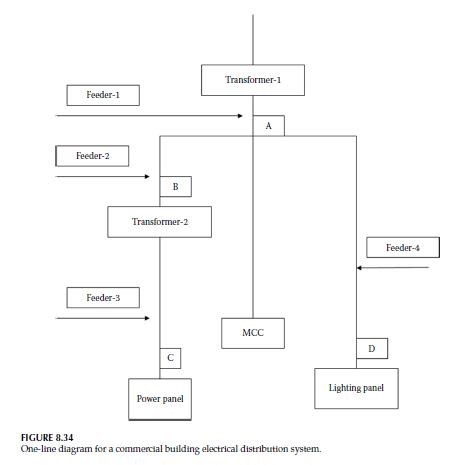
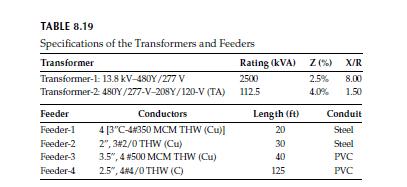
For this problem, consider the single-line diagram for a building power system shown in Figure 8.34. In particular, the utility system short-circuit kVA capability is 850,000 kVA with X/R = 6.0. Table 8.19 shows the impedance and X/R of the transformers. The purpose of this problem is to analyze
Using the radial electrical distribution system of Figure 8.34, determine the unit substation specifications and the electrical room size. The primary feeder is protected by a fused switch.(a) Determine the dimensions of each section of the unit substation.(b) Draw an elevation view of the unit
A homeowner is considering adding a sunspace to his home. The project is completed during 4 years and requires \($20,000\) to be spent the first year, \($15,000\) the second year,(\($10,000\)\) the third year, and \($5,000\) the fourth year. Determine how much money the homeowner needs to set aside
An energy audit indicates that a home consumption is 20,000 kWh/year. By using Energy Star appliances and CFLs, a savings of 20% can be achieved for the electrical energy use. The cost for the home retrofit is about \($15,000.\) Assuming that the average energy charge is \($0.09/kWh,\) is the
An air conditioner (AC) consumes 7500 kWh annually with an overall efficiency of COP = 3.0. If this AC is replaced by a more energy-efficient AC (COP = 3.7) at a cost of $3500.(a) Determine the simple payback period of the chiller replacement.(b) If the expected life of the old chiller is 15 years,
Two air conditioner systems are proposed to cool a house. Each AC has a rated capacity of 5 tons and is expected to operate 500 full-load equivalent hours per year. Air conditioner A has a standard efficiency with a COP of 2.8 and costs \($1600\) while AC B is more efficient with a COP of 3.5 at a
A company has contacted you regarding their rate schedule. The company is on the rate schedule defined in Problem 9.11 as service level 3 (secondary service), but are near transmission lines and so can accept service at a higher level (service level 1) if they buy their own transformers. Assuming
For an apartment building with a total of 20 incandescent lamps rated at 60 W. Determine the energy-saving potential if these lamps are replaced with 13 W CFLs. The lifespan of incandescent lamp and CFL is, respectively, 1300 and 8000 h. Perform the analysis using the lifespan of CFLs. Determine
For a house with a total 20 of incandescent lamps rated at 60 W, determine the energy-saving potential if these lamps are replaced with(a) 13 W CFLs and(b) 7 W LED lamps. The lifespan of incandescent lamp, CFL, and LED lamp is 1,300, 8,000, and 30,000 h, respectively. Perform the analysis using the
Estimate the annual phantom load for a TV with a set-top box if the TV is operated 5 h/day. Determine the annual cost of the phantom load energy if the electricity cost is 0.12/kWh.
Estimate the annual phantom load for an audio mini-system operated 3 h/day. Determine the annual cost of the phantom load energy if the electricity cost is 0.10/kWh.
Consider a ranch house of 100 m2 located in Phoenix, CO, with a total window area of 15 m2 with double-pane glazing that has a visible transmittance of 0.35. The home has 20 incandescent lamps, each rated at 60 W.(a) Estimate the energy use and cost savings when the incandescent lamps are replaced
Determine the energy and cost savings of daylighting harvesting to a thin two-story house building (each floor is 24 ft × 50 ft) with a window-to-floor area ratio of 30%. The building has clear windows (i.e., visible transmittance = 0.78) and is located in Denver, CO. The lighting system has a
Based on the analysis of voltage measured for a lighting panel, it was found that the rms values for the fundamental, the third, the fifth, the seventh, and the ninth harmonics that make up the voltage waveform are the following:Determine the IHD and THD values using the IEEC and IEC definitions. V
Based on the analysis of current measured for a power panel, the rms values for the fundamental, the third, the fifth, and the seventh harmonics that make up the voltage waveform are estimated to be the following: =175 A, 13 85 A, Is=50A, 17 = 25 A
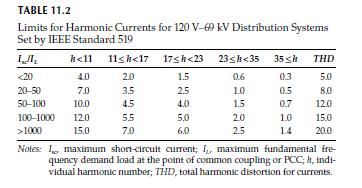
Estimate the current THD of a desktop computer with its monitor. Use the data provided in Table 11.2. TABLE 11.2 Limits for Harmonic Currents for 120 V-69 kV Distribution Systems Set by IEEE Standard 519 II h
Determine the k-factor required for a transformer supplying a load made up of 245 A for fundamental harmonic, 115 A for the third harmonics, 75 A for the fifth harmonics, 50 A for the seventh harmonics, and 30 A for the ninth harmonics.
Determine AC resistance values for a 400 MCM copper conductor serving a lighting panel. Consider the fundamental as well as the third, the fifth, the seventh, and the ninth harmonics.
For the 400 MCM copper conductor, estimate the current rating factor q if the rms current values for the various harmonics are I1 = 310 A (fundamental harmonic), I3 = 120 A (third harmonics), I5 = 165 A (fifth harmonics), I7 = 70 A (seventh harmonics), and I9 = 40 A (ninth harmonics).
A 2500 kVA transformer rated at 13.8 kkVA–480Y/277 V with an impedance of 5%. Determine the resonance frequency as a function of the size in kVAR capacitor banks ranging from 100 to 1000 kVAR. Determine the best option for the capacitor bank.
Showing 100 - 200
of 123
1
2
Step by Step Answers

 Get 50% OFF
Claim Now
Get 50% OFF
Claim Now