New Semester
Started
Get
50% OFF
Study Help!
--h --m --s
Claim Now
Question Answers
Textbooks
Find textbooks, questions and answers
Oops, something went wrong!
Change your search query and then try again
S
Books
FREE
Study Help
Expert Questions
Accounting
General Management
Mathematics
Finance
Organizational Behaviour
Law
Physics
Operating System
Management Leadership
Sociology
Programming
Marketing
Database
Computer Network
Economics
Textbooks Solutions
Accounting
Managerial Accounting
Management Leadership
Cost Accounting
Statistics
Business Law
Corporate Finance
Finance
Economics
Auditing
Tutors
Online Tutors
Find a Tutor
Hire a Tutor
Become a Tutor
AI Tutor
AI Study Planner
NEW
Sell Books
Search
Search
Sign In
Register
study help
engineering
shigleys mechanical engineering design
Shigley's Mechanical Engineering Design 10th Edition Richard Budynas, Keith Nisbett - Solutions
Repeat Probs. 5–27 using the modified-Mohr theory.A cast aluminum 195-T6 exhibits Sut = 36 kpsi, Suc 5 35 kpsi, and εf = 0.045. For the given state of plane stress, (a) Using the Coulomb-Mohr theory, determine the factor of safety, (b) Plot the failure locus and the load line, and
Repeat Probs. 5–26 using the modified-Mohr theory.A cast aluminum 195-T6 exhibits Sut = 36 kpsi, Suc 5 35 kpsi, and εf = 0.045. For the given state of plane stress, (a) Using the Coulomb-Mohr theory, determine the factor of safety, (b) Plot the failure locus and the load line, and
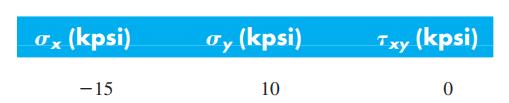
A cast aluminum 195-T6 exhibits Sut = 36 kpsi, Suc 5 35 kpsi, and εf = 0.045. For the given state of plane stress, (a) Using the Coulomb-Mohr theory, determine the factor of safety, (b) Plot the failure locus and the load line, and estimate the factor of safety by graphical measurement.
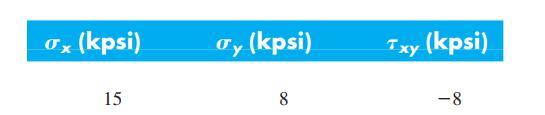
A cast aluminum 195-T6 exhibits Sut = 36 kpsi, Suc 5 35 kpsi, and εf = 0.045. For the given state of plane stress, (a) Using the Coulomb-Mohr theory, determine the factor of safety, (b) Plot the failure locus and the load line, and estimate the factor of safety by graphical measurement.
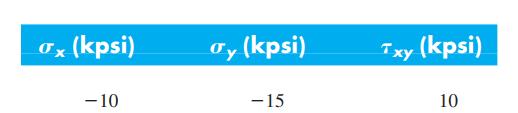
A cast aluminum 195-T6 exhibits Sut = 36 kpsi, Suc 5 35 kpsi, and εf = 0.045. For the given state of plane stress, (a) Using the Coulomb-Mohr theory, determine the factor of safety, (b) Plot the failure locus and the load line, and estimate the factor of safety by graphical measurement.
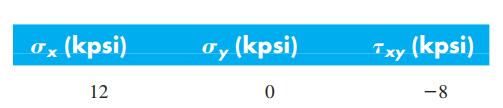
A cast aluminum 195-T6 exhibits Sut = 36 kpsi, Suc 5 35 kpsi, and εf = 0.045. For the given state of plane stress, (a) Using the Coulomb-Mohr theory, determine the factor of safety, (b) Plot the failure locus and the load line, and estimate the factor of safety by graphical measurement.
A cast aluminum 195-T6 exhibits Sut = 36 kpsi, Suc 5 35 kpsi, and εf = 0.045. For the given state of plane stress, (a) Using the Coulomb-Mohr theory, determine the factor of safety, (b) Plot the failure locus and the load line, and estimate the factor of safety by graphical measurement
For an ASTM 30 cast iron, (a) Find the factors of safety using the BCM and MM theories, (b) Plot the failure diagrams in the σA, σB plane to scale and locate the coordinates of the stress state,(c) Estimate the factors of safety from the two theories by graphical measurements along the
For an ASTM 30 cast iron, (a) Find the factors of safety using the BCM and MM theories, (b) Plot the failure diagrams in the σA, σB plane to scale and locate the coordinates of the stress state,(c) Estimate the factors of safety from the two theories by graphical measurements along the
For an ASTM 30 cast iron, (a) Find the factors of safety using the BCM and MM theories, (b) Plot the failure diagrams in the σA, σB plane to scale and locate the coordinates of the stress state,(c) Estimate the factors of safety from the two theories by graphical measurements along the
For an ASTM 30 cast iron, (a) Find the factors of safety using the BCM and MM theories, (b) Plot the failure diagrams in the σA, σB plane to scale and locate the coordinates of the stress state,(c) Estimate the factors of safety from the two theories by graphical measurements along the
For an ASTM 30 cast iron, (a) Find the factors of safety using the BCM and MM theories, (b) Plot the failure diagrams in the σA, σB plane to scale and locate the coordinates of the stress state,(c) Estimate the factors of safety from the two theories by graphical measurements along the
Repeat Prob. 5–19 by first plotting the failure loci in the σA, σB plane to scale; then for each stress state, plot the load line and by graphical measurement estimate the factor of safety.(a) σx = 25 kpsi, σy = 15 kpsi (b) σx = 15 kpsi, σy = -15 kpsi (c) σx = 20 kpsi, τxy =
A brittle material has the properties Sut = 30 kpsi and Suc = 90 kpsi. Using the brittle CoulombMohr and modified-Mohr theories, determine the factor of safety for the following states of plane stress.(a) σx = 25 kpsi, σy = 15 kpsi (b) σx = 15 kpsi, σy = -15 kpsi (c) σx = 20 kpsi,
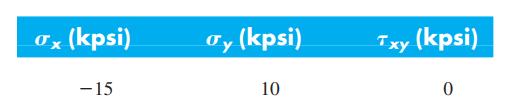
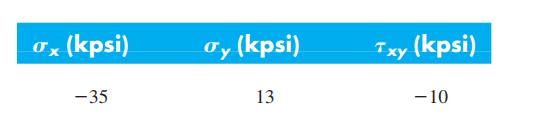
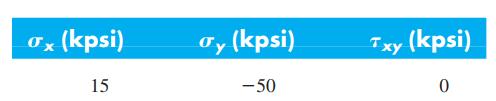
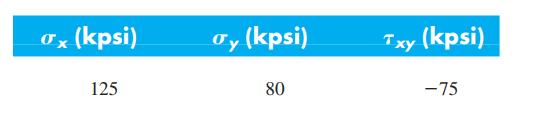
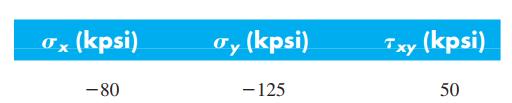
An AISI 4142 steel Q&T at 800°F exhibits Syt = 235 kpsi, Syc = 285 kpsi, and εf = 0.07. For the given state of plane stress, (a) Determine the factor of safety, (b) Plot the failure locus and the load line, and estimate the factor of safety by graphical measurement. 0x (kpsi) Ty
An AISI 4142 steel Q&T at 800°F exhibits Syt = 235 kpsi, Syc = 285 kpsi, and εf = 0.07. For the given state of plane stress, (a) Determine the factor of safety, (b) Plot the failure locus and the load line, and estimate the factor of safety by graphical measurement. 0x (kpsi) Ty
An AISI 4142 steel Q&T at 800°F exhibits Syt = 235 kpsi, Syc = 285 kpsi, and εf = 0.07. For the given state of plane stress, (a) Determine the factor of safety, (b) Plot the failure locus and the load line, and estimate the factor of safety by graphical measurement. Ox (kpsi) Ty
An AISI 4142 steel Q&T at 800°F exhibits Syt = 235 kpsi, Syc = 285 kpsi, and εf = 0.07. For the given state of plane stress, (a) Determine the factor of safety, (b) Plot the failure locus and the load line, and estimate the factor of safety by graphical measurement. Ox (kpsi) Ty
Repeat Prob. 5–12 by first plotting the failure loci in the σA, σB plane to scale; then for each stress state, plot the load line and by graphical measurement estimate the factor of safetyA ductile material has the properties Syt = 60 kpsi and Syc = 75 kpsi. Using the ductile Coulomb-Mohr
A ductile material has the properties Syt = 60 kpsi and Syc = 75 kpsi. Using the ductile Coulomb-Mohr theory, determine the factor of safety for the states of plane stress given in Prob. 5–3.For a bar of AISI 1030 hot-rolled steel and:(a) σx = 25 kpsi, σy = 15 kpsi (b) σx = 15 kpsi, σy =
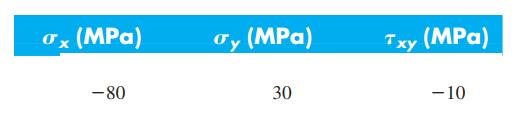
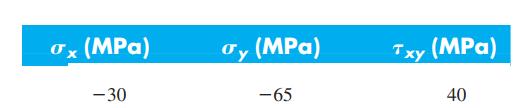
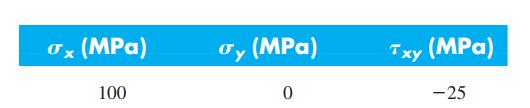
An AISI 1018 steel has a yield strength, Sy = 295 MPa. Using the distortion-energy theory for the given state of plane stress, (a) Determine the factor of safety, (b) Plot the failure locus, the load line, and estimate the factor of safety by graphical measurement. ox (MPa) Ty (MPa) Txy
An AISI 1018 steel has a yield strength, Sy = 295 MPa. Using the distortion-energy theory for the given state of plane stress, (a) Determine the factor of safety, (b) Plot the failure locus, the load line, and estimate the factor of safety by graphical measurement. 0x (MPa) Ty (MPa) Txy
An AISI 1018 steel has a yield strength, Sy = 295 MPa. Using the distortion-energy theory for the given state of plane stress, (a) Determine the factor of safety, (b) Plot the failure locus, the load line, and estimate the factor of safety by graphical measurement. 0x (MPa) Ty (MPa) Txy
An AISI 1018 steel has a yield strength, Sy = 295 MPa. Using the distortion-energy theory for the given state of plane stress, (a) Determine the factor of safety, (b) Plot the failure locus, the load line, and estimate the factor of safety by graphical measurement. 0x (MPa) Oy (MPa) Txy
An AISI 1018 steel has a yield strength, Sy = 295 MPa. Using the distortion-energy theory for the given state of plane stress, (a) Determine the factor of safety, (b) Plot the failure locus, the load line, and estimate the factor of safety by graphical measurement. 0x (MPa) Ty (MPa) Txy
Repeat Prob. 5–1 by first plotting the failure loci in the σA, σB plane to scale; then, for each stress state, plot the load line and by graphical measurement estimate the factors of safety.A ductile hot-rolled steel bar has a minimum yield strength in tension and compression of 350 MPa. Using
Repeat Prob. 5–1 for a bar of AISI 1015 cold-drawn steel with the following principal stresses obtained from Eq. (3–13):(a) σA = 30 kpsi , σB = 30 kpsi (b) σA = 30 kpsi , σB = -30 kpsi (c) σA = 30 kpsi , σB = 15 kpsi (d) σA = -30 kpsi , σB = -15 kpsi (e) σA = -50
Repeat Prob. 5–1 for a bar of AISI 1030 hot-rolled steel and:(a) σx = 25 kpsi, σy = 15 kpsi (b) σx = 15 kpsi, σy = -15 kpsi (c) σx = 20 kpsi, σy = −10 kpsi (d) σx = -12 kpsi , σy = 15 kpsi , τxy = -9 kpsi (e) σx = -24 kpsi , σy = -24 kpsi , τxy = -15 kpsi
Repeat Prob. 5–1 with the following principal stresses obtained from Eq. (3–13):(a) σA = 100 MPa, σB = 100 MPa(b) σA = 100 MPa, σB = -100 MPa(c) σA = 100 MPa, σB = 50 MPa(d) σA = 100 MPa, σB = -50 MPa(e) σA = -50 MPa, σB = -100 MPa Ox + Oy 土 + Ty O1, 02 = 2 2. 2.
A ductile hot-rolled steel bar has a minimum yield strength in tension and compression of 350 MPa. Using the distortion-energy and maximum-shear-stress theories determine the factors of safety for the following plane stress states:(a) σx = 100 MPa, σy = 100 MPa(b) σx = 100 MPa, σy = 50 MPa(c)
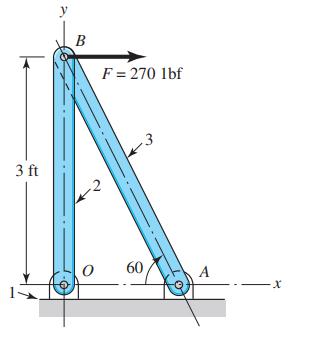
Link 3, shown schematically in the figure, acts as a brace to support the 270-lbf load. For buckling in the plane of the figure, the link may be regarded as pinned at both ends. For out-of-plane buckling, the ends are fixed. Select a suitable material and a method of manufacture, such as forging,
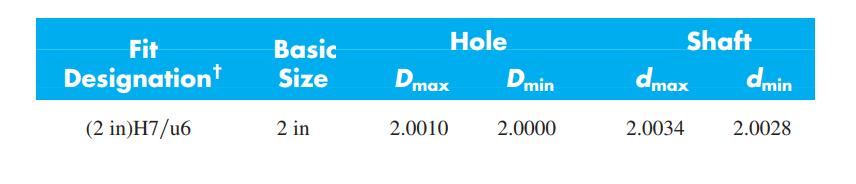
The table lists the maximum and minimum hole and shaft dimensions for a variety of standard press and shrink fits. The materials are both hot-rolled steel. Find the maximum and minimum values of the radial interference and the corresponding interface pressure. Use a collar diameter of 100 mm for
Research the material Inconel, briefly described in Table A–5. Compare it to various carbon and alloy steels in stiffness, strength, ductility, and toughness. What makes this material so special?
Search the website noted in Sec. 2–20 (http://composite.about.com/cs/software/) and report your findings. Your instructor may wish to elaborate on the level of this report. The website contains a large variety of resources. The activity for this problem can be divided among the class.
Repeat Prob. 2–18 for the commonly used alloy steels, AISI 4130 and 4340.Prob. 2–18Some commonly used plain carbon steels are AISI 1010, 1018, and 1040. Research these steels and provide a comparative summary of their characteristics, focusing on aspects that make each one unique for certain
Some commonly used plain carbon steels are AISI 1010, 1018, and 1040. Research these steels and provide a comparative summary of their characteristics, focusing on aspects that make each one unique for certain types of application. Product application guides provided on the Internet by steel
A steel member has a Brinell of HB = 275. Estimate the ultimate strength of the steel in MPa.
A round cold-drawn 1045 steel rod has a mean strength S̅y = 95.5 kpsi with a standard deviation of σ̂ = 6.59 kpsi. The rod is to be subjected to a mean static axial load of P̅ = 65 kip with a standard deviation of σ̂P = 5.0 kip.
Estimate how many times more expensive it is to grind a steel part to a tolerance of ±0.0005 in versus turning it to a tolerance of ±0.003 in.
Go to the Internet and connect to the NSPE website (www.nspe.org/ethics). Go to Ethics Resources and review one or more of the topics given. A sample of some of the topics may be:(a) Education Publications(b) Ethics Case Search(c) Ethics Exam(d) FAQ(e) Milton Lunch Contest(f) Other Resources(g) You
Go to the Internet and connect to the NSPE website (www.nspe.org/ethics). Read the complete NSPE Code of Ethics for Engineers and briefly discuss your reading.
Go to the Internet and connect to the NSPE website (www.nspe.org/ethics). Read the history of the Code of Ethics and briefly discuss your reading.
Select an organization listed in Sec. 1–6, go to the Internet, and list what information is available on the organization.
Select a mechanical component from Part 3 of this book (roller bearings, springs, etc.), go to the Internet, and, using a search engine, report on the information obtained on five manufacturers or suppliers.
Select a mechanical component from Part 3 of this book (roller bearings, springs, etc.), go to your university’s library or the appropriate internet website, and, using the Thomas Register of American Manufacturers (www.thomasnet.com), report on the information obtained on five manufacturers or
Showing 100 - 200
of 145
1
2
Step by Step Answers

 Get 50% OFF
Claim Now
Get 50% OFF
Claim Now