







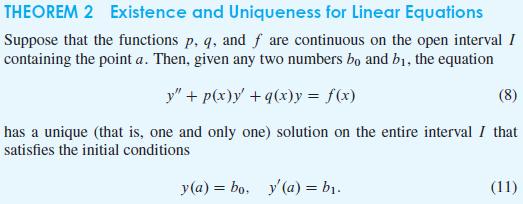
Question: Given a mass m, a dashpot constant c, and a spring constant k, Theorem 2 of Section 5.1 implies that the equation has a unique
Given a mass m, a dashpot constant c, and a spring constant k, Theorem 2 of Section 5.1 implies that the equation

has a unique solution for t ≧ 0 satisfying given initial conditions x (0) = x0, x'(0) = v0. Thus the future motion of an ideal mass-spring-dashpot system is completely determined by the differential equation and the initial conditions. Of course in a real physical system it is impossible to measure the parameters m, c, and k precisely. Problems 35 through 38 explore the resulting uncertainty in predicting the future behavior of a physical system.
Suppose that m = 1, c = 2, and k = 1 in Eq. (26). Show that the solution with x (0) = 0 and x' (0) = 1 is
x1(t) = te-t.
mx" + cx' + kx = 0 (26)
Step by Step Solution
3.34 Rating (151 Votes )
There are 3 Steps involved in it
The characteristic equation r 2r10 ... View full answer

Get step-by-step solutions from verified subject matter experts
 Study Help