







Question: Given a mass m, a dashpot constant c, and a spring constant k, Theorem 2 of Section 5.1 implies that the equation has a unique
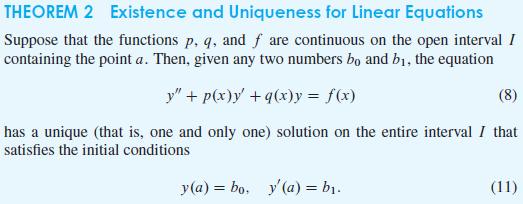
Given a mass m, a dashpot constant c, and a spring constant k, Theorem 2 of Section 5.1 implies that the equation

has a unique solution for t ≧ 0 satisfying given initial conditions x (0) = x0, x'(0) = v0. Thus the future motion of an ideal mass-spring-dashpot system is completely determined by the differential equation and the initial conditions. Of course in a real physical system it is impossible to measure the parameters m, c, and k precisely. Problems 35 through 38 explore the resulting uncertainty in predicting the future behavior of a physical system.
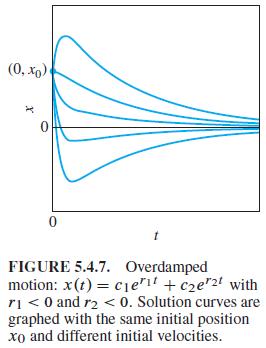
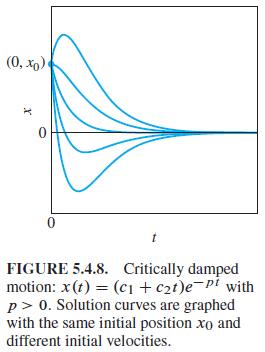
Whereas the graphs of x1 (t) and x2 (t) resemble those shown in Figs. 5.4.7 and 5.4.8, the graph of x3 (t) exhibits damped oscillations like those illustrated in Fig. 5.4.9, but with a very long pseudoperiod. Nevertheless, show that for each fixed t > 0 it is true that

mx" + cx' + kx = 0 (26)
Step by Step Solution
3.42 Rating (174 Votes )
There are 3 Steps involved in it
This follows from and lim x tlim10e sinh10tt... View full answer

Get step-by-step solutions from verified subject matter experts
 Study Help