







Question: Consider fully developed two-dimensional Poiseuille flowflow between two infinite parallel plates separated by distance h, with both the top plate and bottom plate stationary, and
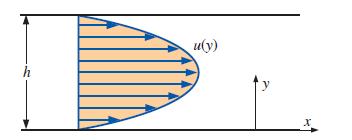
Consider fully developed two-dimensional Poiseuille flow—flow between two infinite parallel plates separated by distance h, with both the top plate and bottom plate stationary, and a forced pressure gradient dP/dx driving the flow as illustrated in Fig. P4–99. (dP/dx is constant and negative.)
The flow is steady, incompressible, and two-dimensional in the xy-plane. The velocity components are given by
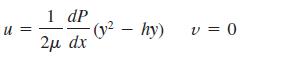
where μ is the fluid’s viscosity. Is this flow rotational or irrotational? If it is rotational, calculate the vorticity component in the z-direction. Do fluid particles in this flow rotate clockwise or counterclockwise?
Fig. P4–99.
u 1 dp 2 dx -(y - hy) v=0
Step by Step Solution
3.39 Rating (168 Votes )
There are 3 Steps involved in it

Get step-by-step solutions from verified subject matter experts
 Study Help