







Question: In this problem, we prove that the average depth of a node in a randomly built binary search tree with n nodes is O(lg n).
In this problem, we prove that the average depth of a node in a randomly built binary search tree with n nodes is O(lg n). Although this result is weaker than that of Theorem 12.4, the technique we shall use reveals a surprising similarity between the building of a binary search tree and the execution of RANDOMIZED QUICKSORT from Section 7.3.
We define the total path length P(T) of a binary tree T as the sum, over all nodes x in T, of the depth of node x, which we denote by d(x, T).
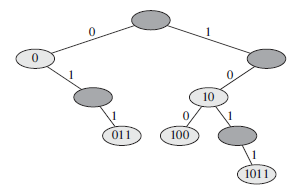
Figure 12.5 A radix tree storing the bit strings 1011, 10, 011, 100, and 0. We can determine each node€™s key by traversing the simple path from the root to that node. There is no need, therefore, to store the keys in the nodes; the keys appear here for illustrative purposes only. Nodes are heavily shaded if the keys corresponding to them are not in the tree; such nodes are present only to establish a path to other nodes.
a. Argue that the average depth of a node in T is
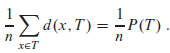
Thus, we wish to show that the expected value of P(T) is O(n lg n).
b. Let TL and TR denote the left and right subtrees of tree T, respectively. Argue that if T has n nodes, then

c. Let P(n) denote the average total path length of a randomly built binary search tree with n nodes. Show that

d. Show how to rewrite P(n) as
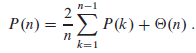
e. Recalling the alternative analysis of the randomized version of quicksort given in Problem 7-3, conclude that P(n) = O(n lg n).
At each recursive invocation of quicksort, we choose a random pivot element to partition the set of elements being sorted. Each node of a binary search tree partitions the set of elements that fall into the subtree rooted at that node.
f. Describe an implementation of quicksort in which the comparisons to sort a set of elements are exactly the same as the comparisons to insert the elements into a binary search tree. (The order in which comparisons are made may differ, but the same comparisons must occur.)
10 011 100 1011 -P(T) -(, T) (T) . ET
Step by Step Solution
3.51 Rating (158 Votes )
There are 3 Steps involved in it
a The total path lengthPTis defined as x T dx T Dividing both quantities by n gives the desired equation b For any nodexinT L we havedx T L dx T 1 sin... View full answer

Get step-by-step solutions from verified subject matter experts
 Study Help