







Question: An alternative version of the Dijkstra algorithm can be described as follows: The algorithm uses cost[v] to store the cost of a shortest path from
An alternative version of the Dijkstra algorithm can be described as follows:
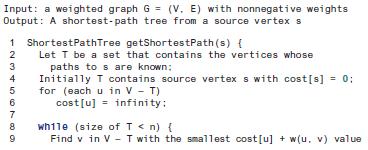
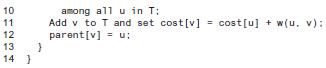
The algorithm uses cost[v] to store the cost of a shortest path from vertex v to the source vertex s. cost[s] is 0. Initially assign infinity to cost[v] to indicate that no path is found from v to s. Let V denote all vertices in the graph and T denote the set of the vertices whose costs are known. Initially, the source vertex s is in T. The algorithm repeatedly finds a vertex u in T and a vertex v in V–T such that cost[u] + w(u, v) is the smallest, and moves v to T. The shortest-path algorithm given in the text continuously updates the cost and parent for a vertex in V–T. This algorithm initializes the cost to infinity for each vertex and then changes the cost for a vertex only once when the vertex is added into T. Implement this algorithm and use Listing 29.7, TestShortestPath.java, to test your new algorithm.
Data from Listing 29.7,
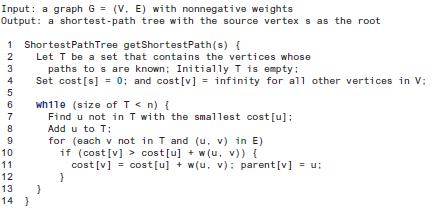
Input: a weighted graph G = (V. E) with nonnegative weights Output: A shortest-path tree from a source vertex s 1 ShortestPathTree getShortestPath(s) { 2 Let T be a set that contains the vertices whose paths to s are known: Initially T contains source vertex s with cost[s] = 0: for (each u in V - T) cost[u] = infini ty: 3 4 6 7 wh1le (size of T < n) { Find v in V - T with the smallest cost[u] + w(u. v) value 9
Step by Step Solution
3.49 Rating (156 Votes )
There are 3 Steps involved in it
import javautil public class Exercise2918 public static void mainString args String vertices Seattle San Francisco Los Angeles Denver Kansas City Chicago Boston New York Atlanta Miami Dallas Houston i... View full answer

Get step-by-step solutions from verified subject matter experts
 Study Help