







Question: EXAMPLE 4.1b Suppose that an individual purchases two electronic components each of which may be either defective or acceptable. In addition, suppose that the four
EXAMPLE 4.1b Suppose that an individual purchases two electronic components each of which may be either defective or acceptable. In addition, suppose that the four possible results —
(d, d ),
(d, a),
(a, d ),
(a,
a) — have respective probabilities .09, .21, .21, .49
[where
(d, d ) means that both components are defective,
(d,
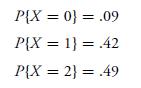
a) that the first component is defective and the second acceptable, and so on]. If we let X denote the number of acceptable components obtained in the purchase, then X is a random variable taking on one of the values 0, 1, 2 with respective probabilities
If we were mainly concerned with whether there was at least one acceptable component, we could define the random variable I by
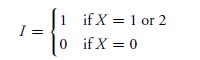
If A denotes the event that at least one acceptable component is obtained, then the random variable I is called the indicator random variable for the event A, since I will equal 1 or 0 depending upon whether A occurs. The probabilities attached to the possible values of I are
P{X = 0} = .09 P{X = 1}= .42 P{X=2} = .49
Step by Step Solution
There are 3 Steps involved in it

Get step-by-step solutions from verified subject matter experts
 Study Help