







Question: Use the convolution formula, Theorem 6.9, to obtain the density of (X+Y) when (X) and (Y) are independent and each has the exponential distribution with
Use the convolution formula, Theorem 6.9, to obtain the density of \(X+Y\) when \(X\) and \(Y\) are independent and each has the exponential distribution with \(\beta=1\).
Data From Theorem 6.9
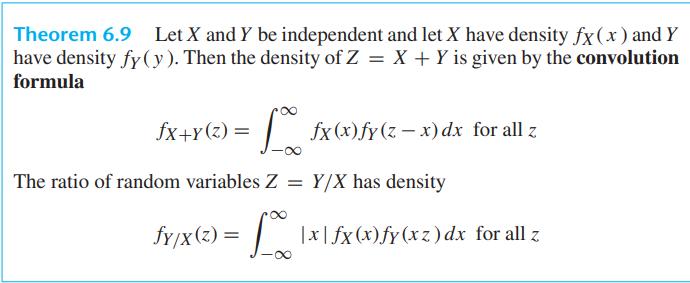
Theorem 6.9 Let X and Y be independent and let X have density fx(x) and Y have density fy (y). Then the density of Z = X + Y is given by the convolution formula fx+y(z) = fx(x)fy(z - x) dx for all z The ratio of random variables Z = Y/X has density |x| fy/x(z) = | | x | x(x)fy(xz) dx for all z
Step by Step Solution
★★★★★
3.34 Rating (145 Votes )
There are 3 Steps involved in it
1 Expert Approved Answer
Step: 1 Unlock

Question Has Been Solved by an Expert!
Get step-by-step solutions from verified subject matter experts
Step: 2 Unlock
Step: 3 Unlock
 Study Help