







Question: Neither Example 4.4 nor Problem 4.73 actually solved the Schrdinger equation for the SternGerlach experiment. In this problem we will see how to set up
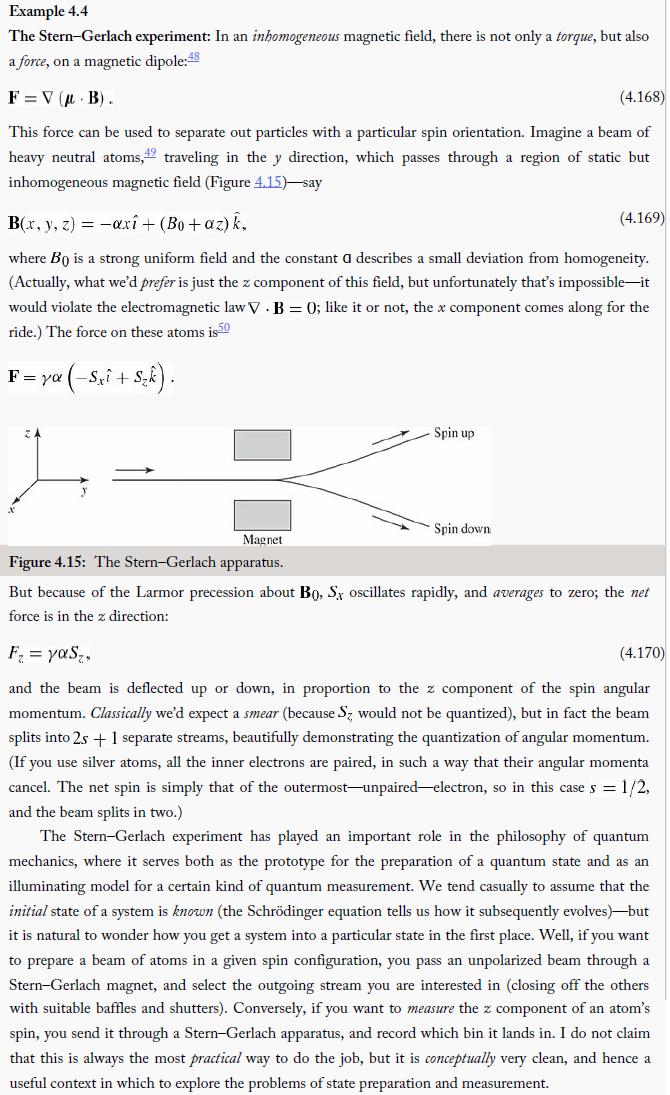
Neither Example 4.4 nor Problem 4.73 actually solved the Schrödinger equation for the Stern–Gerlach experiment. In this problem we will see how to set up that calculation. The Hamiltonian for a neutral, spin- 1/2 particle traveling through a Stern–Gerlach device is
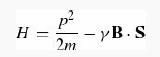
where B is given by Equation 4.169. The most general wave function for a spin- 1/2 particle—including both spatial and spin degrees of freedom—is (a) Put Ψ (r, t) into the Schrödinger equation
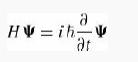 to obtain a pair of coupled equations for Ψ±.
 (b) We know from Example 4.3 that the spin will precess in a uniform field B0k̂. We can factor this behavior out of our solution—with no loss of generality—by writing
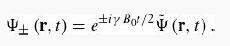 Find the coupled equations for Ψ̅±.

(c) If one ignores the oscillatory term in the solution to (b)—on the grounds that it averages to zero (see discussion in Example 4.4)—one obtains uncoupled equations of the form
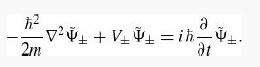
Based upon the motion you would expect for a particle in the “potential” V±, explain the Stern–Gerlach experiment.
Example 4.4
H = p 2m - YB. S
Step by Step Solution
3.45 Rating (164 Votes )
There are 3 Steps involved in it
a Write S in terms of raising and lowering operators Then whil... View full answer

Get step-by-step solutions from verified subject matter experts
 Study Help