



Question: Write a program in (mathrm{R}) that generates (b) samples of size (n) from a density that is a mixture of two NORmaL densities given by
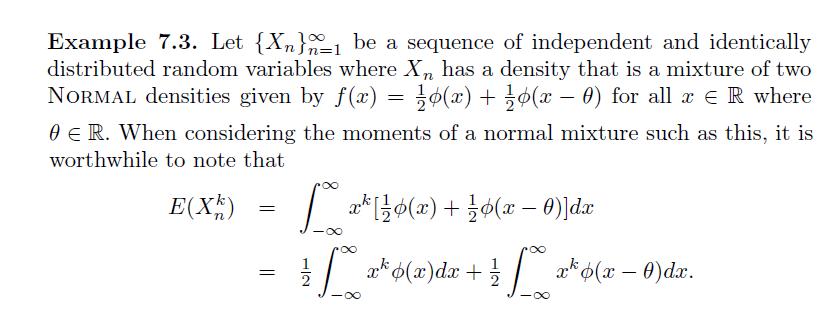
Write a program in \(\mathrm{R}\) that generates \(b\) samples of size \(n\) from a density that is a mixture of two NORmaL densities given by \(f(x)=\frac{1}{2} \phi(x)+\frac{1}{2} \phi(x-\theta)\) for all \(x \in \mathbb{R}\) where \(\theta \in \mathbb{R}\). In Example 7.3 we found that \(E\left(X_{n}ight)=\frac{1}{2} \theta, E\left(X_{n}^{2}ight)=\) \(1+\frac{1}{2} \theta^{2}, E\left(X_{n}^{3}ight)=\frac{1}{2} \theta^{3}+\frac{3}{2} \theta\), and \(E\left(X_{n}^{4}ight)=-\frac{1}{2} \theta^{4}+\frac{3}{2} \theta^{2}+3\). The third and fourth moments of the normal mixture are \(\mu_{3}=0\) and \(\mu_{4}=-\frac{3}{16} \theta^{4}+\frac{3}{2} \theta^{2}+3\). The third cumulant is also zero, and the fourth cumulant is \(\kappa_{4}=-\frac{15}{16} \theta^{4}-\) \(\frac{3}{2} \theta^{2}\). For each sample compute the statistic \(Z_{n}=n^{1 / 2} \sigma^{-1}\left(\bar{X}_{n}-\muight)\) where \(\mu\) and \(\sigma\) correspond to the mean and standard deviation specified above. Produce a plot of the empirical distribution function of the \(b\) values of \(Z_{n}\). On each plot overlay a plot of the standard normal distribution function and the function given by the one-term Edgeworth expansion. Discuss how these functions compare to what would be expected for large \(n\) as regulated by the underlying theory given by Theorems 4.20 and 7.4. Run this simulation for \(n=10,25,50\), and 100 each with \(\theta=0,0.50,1.00\), and 3.00 .
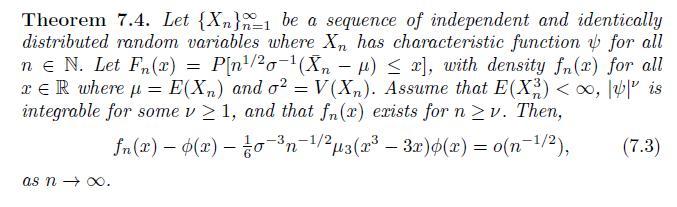
Theorem 7.4. Let {X} be a sequence of independent and identically distributed random variables where Xn has characteristic function for all n N. Let Fn(x) Pn1/20 (n) x], with density fn(x) for all x = R where = E(X) and o = V(Xn). Assume that E(X3) < , || is integrable for some v1, and that fn(x) exists for n > v. Then, = -3 fn(x)-(x) o n1/2 3(x 3x)(x) = o(n1/2), - - (7.3) as n .
Step by Step Solution
3.45 Rating (155 Votes )
There are 3 Steps involved in it

Get step-by-step solutions from verified subject matter experts