



Question: Write a program in (mathrm{R}) that simulates samples of size (n=1, ldots, 100) from a distribution (F), where (F) is specified below. For each sample
Write a program in \(\mathrm{R}\) that simulates samples of size \(n=1, \ldots, 100\) from a distribution \(F\), where \(F\) is specified below. For each sample compute the fourth sample central moment, as well as \(\tilde{\mu}_{1}\) and \(\tilde{\mu}_{4}\) where
\[\tilde{\mu}_{k}=n^{-1} \sum_{i=1}^{n}\left(X_{i}-\muight)^{k}\]
and \(X_{1}, \ldots, X_{n}\) denotes the simulated sample. For each value of \(n\), compute \(n^{1 / 2}\left(\hat{\mu}_{4}-\mu_{4}ight), n^{1 / 2}\left(\tilde{\mu}_{4}-\mu_{4}-4 \mu_{3} \tilde{\mu}_{1}ight)\), and the absolute difference between the two expressions. Repeat the experiment five times and plot the resulting sequences of differences against \(n\). Compare the limiting behavior of the absolute differences to what would be expected given the theory in Theorem 8.4, noting that the assumptions of the example are not met for all of the specified distributions given below.
a. \(\mathrm{N}(0,1)\)
b. \(\operatorname{Cauchy}(0,1)\)
c. \(\mathrm{T}(3)\)
d. Exponential(1)
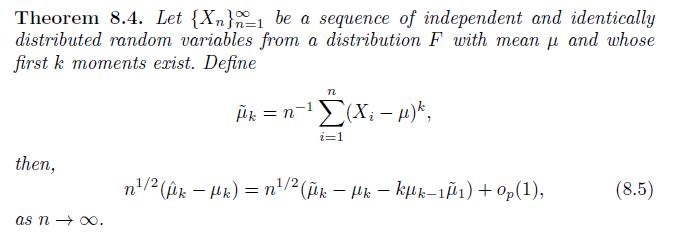
Theorem 8.4. Let {X} be a sequence of independent and identically distributed random variables from a distribution F with mean and whose first k moments exist. Define then, as n . n k = n (Xi-), i=1 n1/2 (k-k) = n/2 (k - k - kpk-11) + Op(1), (8.5)
Step by Step Solution
3.51 Rating (158 Votes )
There are 3 Steps involved in it

Get step-by-step solutions from verified subject matter experts