







Question: The following is a deterministic dynamic programming problem. A company is planning a marketing strategy for a new product. There are three phases of the
The following is a deterministic dynamic programming problem. A company is planning a marketing strategy for a new product. There are three phases of the plan: (1) an introductory low price; (2) a subsequent intensive advertising campaign in newspapers and magazines; and (3) a follow-up ad campaign on radio. A total of \(\$ 4\) million, which can be spent in \(\$ 1\) million blocks, is available. After each phase, it is possible for the product to have one of the following shares of the market:
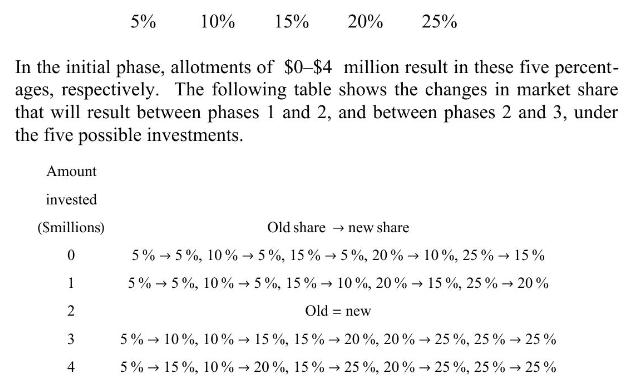
Find the amount of money to be allocated in each phase in order to maximize the share of the market at the end of the plan (there is no single period reward \(r\) ).
5% 10% 15% 20% 25% In the initial phase, allotments of $0-$4 million result in these five percent- ages, respectively. The following table shows the changes in market share that will result between phases 1 and 2, and between phases 2 and 3, under the five possible investments. Amount invested (Smillions) 0 Old share new share 5%-5%, 10%-5%, 15% -> 5%, 20% -> 10%, 25% 15% 5% 5%, 10% 5%, 15% 10 %, 20% -> 15 %, 25% -20% 1 2 3 5%-10%, 10% 4 Old = new 15%, 15% 20%, 20% 25 %, 25% 25% -> 5%-15%, 10% 20 %, 15% 25 %, 20% 25%, 25% 25 %
Step by Step Solution
3.53 Rating (153 Votes )
There are 3 Steps involved in it

Get step-by-step solutions from verified subject matter experts
 Study Help