







Question: Given the following class, which instance initializer block inserted independently at (1) will allow the class to be compiled? Select the one correct answer. (a)
Given the following class, which instance initializer block inserted independently at (1) will allow the class to be compiled?
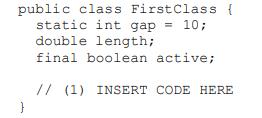
Select the one correct answer.
(a) instance { active = true; }
(b) FirstClass { gap += 5; }
(c) { gap = 5; length = (active ? 100 : 200) + gap; }
(d) { ; }
(e) { length = 4.2; }
(f) { active = (gap > 5); length = 5.5 + gap;}
public class First Class { static int gap = 10; double length; final boolean active; // (1) INSERT CODE HERE }
Step by Step Solution
3.29 Rating (167 Votes )
There are 3 Steps involved in it
f This class has a blank final boolean instance variable active This variable must be initialized when an instance is constructed or else the code will not compile This also applies to blank final static variables The keyword static is used to signify that a block is a static initializer block No keyword is used to signify that a block is an instance initializer block a and b are not instance initializers blocks and c d and e fail to initialize ... View full answer

Get step-by-step solutions from verified subject matter experts
 Study Help