New Semester
Started
Get
50% OFF
Study Help!
--h --m --s
Claim Now
Question Answers
Textbooks
Find textbooks, questions and answers
Oops, something went wrong!
Change your search query and then try again
S
Books
FREE
Study Help
Expert Questions
Accounting
General Management
Mathematics
Finance
Organizational Behaviour
Law
Physics
Operating System
Management Leadership
Sociology
Programming
Marketing
Database
Computer Network
Economics
Textbooks Solutions
Accounting
Managerial Accounting
Management Leadership
Cost Accounting
Statistics
Business Law
Corporate Finance
Finance
Economics
Auditing
Tutors
Online Tutors
Find a Tutor
Hire a Tutor
Become a Tutor
AI Tutor
AI Study Planner
NEW
Sell Books
Search
Search
Sign In
Register
study help
mathematics
calculus 6th edition
Calculus 6th Edition James Stewart - Solutions
Find the volume of the solid that lies under the plane 3x + 2y + z = 12 and above the rectangle R = {(x, y) |0 ≤ x ≤ 1, –2 ≤ y ≤ 3}.
Find the volume of the solid that lies under the hyperbolic paraboloid z = 4 + x2 – y2 and above the square R = [–1, 1] x [0, 2].
Use spherical coordinates.Evaluate ∫∫∫E xyz dV, where E lies between the spheres ρ = 2 and ρ = 4 and above the cone Φ = π/3.
Use polar coordinates to find the volume of the given solid.Bounded by the paraboloids z = 3x2 + 3y2 and z = 4 = – x2 – y2
Find the volume of the solid lying under the elliptic paraboloid x2/4 + y2/9 + z = 1 and above the rectangle R = [–1, 1] x [–2.2].
Find the volume of the solid enclosed by the surface z = 1 + ex sin y and the planes x = ±1, y = 0, y = π, and z = 0.
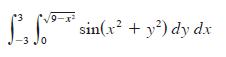
Evaluate the iterated integral by converting to polar coordinates. 9-x² S²³₂ foº* sin(x² + y²) dy dx -3 JO
Find the volume of the solid enclosed by the surface z = x sec2y and the planes z = 0, x = 0, x = 2, y = 0, and y = π/4.
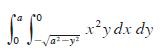
Evaluate the iterated integral by converting to polar coordinates. So Sºve Jo a²-y² x²y dx dy
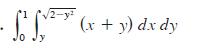
Evaluate the iterated integral by converting to polar coordinates. √2-y² ( (x + y) dx dy 10 Jy
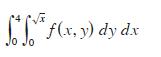
Sketch the region of integration and change the order of integration. f*f* f(x, y) dy dx Jo Jo
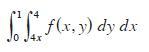
Sketch the region of integration and change the order of integration. f(x, y) dy dx Jo J4x'
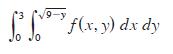
Sketch the region of integration and change the order of integration. 9-1 f(x,y) dx dy 19-y
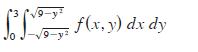
Sketch the region of integration and change the order of integration. √√9-3 ³ [√³* f(x, y) dx dy Jo Jo
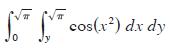
Evaluate the integral by reversing the order of integration. S √ f√™* cos(x²) dx dy
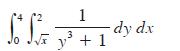
Evaluate the integral by reversing the order of integration. . ܐ ܐ ܂ 3 1 + 1 dy dx
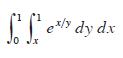
Evaluate the integral by reversing the order of integration. 10 exy dy dx
Prove Property 11. IIIf m≤ f(x, y) < M for all (x, y) in D, then mA(D) < ff f(x, y) dA ≤ MA(D)
Use symmetry to evaluate ∫∫D(2 – 3x + 4y) dA, where D is the region bounded by the square with vertices (±5,0) and (0, ±5).
Evaluate ∫∫D(x2 tan x + y3 + 4) dA, where D = {(x, y) | x2 + y2 ≤ 2}.
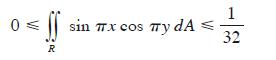
Use the result of Exercise 17 to show thatwhereData from Exercises 17If f is a constant function, f(x, y) = k, and R = [a, b] x [c, d], show that ∫∫R k dA = k(b – a)(d – c). 0≤ SS sin πx cos πy dА < R 1 32
Calculate the double integral. R 1 + x² -dA, R= {(x, y) |0 ≤ x ≤ 1,0 ≤ y ≤ 1} 1+ y²
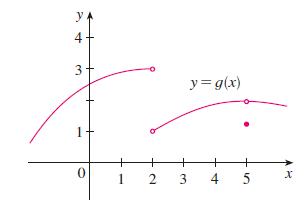
The graph of a function g is shown in Figure 10. Use it to state the values (if they exist) of the following:Figure 10 (a) lim g(x) x-2- (d) lim g(x) X-5- (b) lim g(x) X-2+ (e) lim g(x) X-5+ (c) lim g(x) (f) lim g(x) X-5
If f(x)= x3 - x, find f"(x) and f(4)(x).
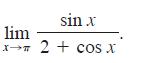
Evaluate sin x lim X→ 2 + cos Xx
Let D(t) be the US national debt at time t. The table in the margin gives approximate values of this function by providing end of year estimates, in billions of dollars, from 1980 to 2000. Interpret and estimate the value of D'(1990).
Evaluate lim sin .x.
Show that limx→0 |x| = 0.
Findif it exists. 1 lim 2 x-0 X →0
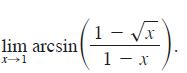
Evaluate lim arcsin| x→1 1-√√√x 1 - X
Prove that does not exist. x lim X-0 X
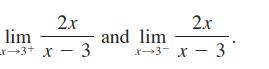
Find 2x lim -x-3+ x - 3 2.x x-3-x - 3 and lim
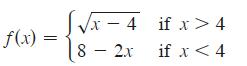
Ifdetermine whether limx→4 f(x) exists. f(x) = √√√x-4 if x > 4 8- 2x if x < 4
Where are the following functions continuous? (a) h(x) = sin(x2) (b) F(x) = ln(1 + cos x)
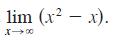
Find lim (x²-x). x →∞
Find the vertical asymptotes of f(x) = tan x.
The greatest integer function is defined by [x] = the largest integer that is less than or equal to x.Show that limx→3 [x] does not exist. (For instance, [4] = 4, [4.8] = 4, [π] = 3, [√2] = 1, [-] = −1.) -
Show that there is a root of the equation 4x3 – 6x2 + 3x – 2 = 0 between 1 and 2.
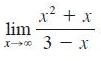
Find x + zx lim X-X 3 x
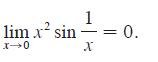
Show that 1 lim x² sin = 0. x-0 X
Sketch the graph of y = (x – 2)4(x + 1)3(x – 1) by finding its intercepts and its limits as x → ∞ and as x → –∞.
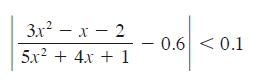
Use a graph to find a number N such that if x > N then 3x² - x - 2 5x² + 4x + 1 0.6 0.1
How many lines are tangent to both of the parabolas y = –1 – x2 and y = 1 + x2? Find the coordinates of the points at which these tangents touch the parabolas.
Use the fact that the world population was 2560 million in 1950 and 3040 million in 1960 to model the population of the world in the second half of the 20th century. (Assume that the growth rate is proportional to the population size.) What is the relative growth rate? Use the model to estimate the
(a) If f(x) = xex, find f'(x). (b) Find the nth derivative, f(n)(x).
(a) If x2 + y2 = 25, find dy/dx (b) Find an equation of the tangent to the circle x2 + y2 = 25 at the point (3, 4).
Differentiate y = ln(x3 + 1).
The position of a particle is given by the equationwhere is measured in seconds and in meters.(a) Find the velocity at time t.(b) What is the velocity after 2 s? After 4 s?(c) When is the particle at rest?(d) When is the particle moving forward (that is, in the positive direction)?(e) Draw a
Air is being pumped into a spherical balloon so that its volume increases at a rate of 100 cm3/s. How fast is the radius of the balloon increasing when the diameter is 50 cm?
Prove (a) cosh2x – sinh2x = 1 (b) 1 – tanh2x = sech2x.
Differentiate y = x2 sin x.
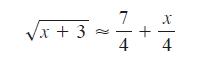
Find the linearization of the function f(x) = √x + 3 at a = 1 and use it to approximate the numbers √3.98 and √4.05. Are these approximations overestimates or underestimates?
Differentiate (a) y = sin(x2) (b) y = sin2x.
For what values of c does the equation In x = cx2 have exactly one solution?
The half-life of radium-226 is 1590 years.(a) A sample of radium-226 has a mass of 100 mg. Find a formula for the mass of the sample that remains after years.(b) Find the mass after 1000 years correct to the nearest milligram.(c) When will the mass be reduced to 30 mg?
Differentiate the function f(t) = √t (a + bt).
Find d/dx In(sin x).
A ladder 10 ft long rests against a vertical wall. If the bottom of the ladder slides away from the wall at a rate of 1 ft/s, how fast is the top of the ladder sliding down the wall when the bottom of the ladder is 6 ft from the wall?
(a) Find y' if x3 + y3 = 6xy. (b) Find the tangent to the folium of Descartes x3 + y3 = 6xy at the point (3, 3). (c) At what points in the first quadrant is the tangent line horizontal?
If a rod or piece of wire is homogeneous, then its linear density is uniform and is defined as the mass per unit length (ρ = m/l) and measured in kilograms per meter. Suppose, however, that the rod is not homogeneous but that its mass measured from its left end to a point x is m = f(x), as shown
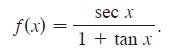
Differentiate For what values of x does the graph of f have a horizontal tangent? f(x)= sec x 1 + tan x
For what values of x is the linear approximationaccurate to within 0.5? What about accuracy to within 0.1? √x + 3 12 4 |- 4
Compare the values of Δy and dy if y = f(x) = x3 + x2 – 2x + 1 and x changes (a) From 2 to 2.05(b) From 2 to 2.01.
Differentiate y = (x3 – 1)100
Find equations of the tangent line and normal line to the curve y = x√x at the point (1, 1). Illustrate by graphing the curve and these lines.
A bottle of soda pop at room temperature (72°F) is placed in a refrigerator where the temperature is 44°F. After half an hour the soda pop has cooled to 61°F. (a) What is the temperature of the soda pop after another half hour? (b) How long does it take for the soda pop to cool to 50°F?
If f(x) = √x g(x), where g(4) = 2 and g'(4) = 3, find f'(4).
Differentiate f(x) = √In x.
A water tank has the shape of an inverted circular cone with base radius 2 m and height 4 m. If water is being pumped into the tank at a rate of 2 m3/min, find the rate at which the water level is rising when the water is 3 m deep.
Find y' if sin(x + y) = y2 cos x.
Show that sinh–1 x = ln(x + √x2 + 1).
An object at the end of a vertical spring is stretched 4 cm beyond its rest position and released at time t = 0. (See Figure 5 and note that the downward direction is positive.) Its position at time t isFind the velocity and acceleration at time t and use them to analyze the motion of the object. s
The radius of a sphere was measured and found to be 21 cm with a possible error in measurement of at most 0.05 cm. What is the maximum error in using this value of the radius to compute the volume of the sphere?
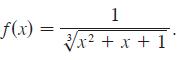
Find f'(x) if 1 √√x² + x + 1
Differentiate f(x) = log10(2 + sin x).
Car A is traveling west at 50 mi/h and car B is traveling north at 60 mi/h. Both are headed for the intersection of the two roads. At what rate are the cars approaching each other when car A is 0.3 mi and car B is 0.4 mi from the intersection?
Find y" if x4 + y4 = 16.
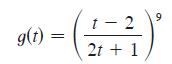
Find the derivative of the function g(t) t - 2 2t + 1 9
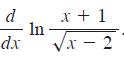
Find d dx In x + 1 √x - 2
A man walks along a straight path at a speed of 4 ft/s. A searchlight is located on the ground 20 ft from the path and is kept focused on the man. At what rate is the searchlight rotating when the man is 15 ft from the point on the path closest to the searchlight?
Find an equation of the tangent line to the curve y = ex/(1 + x2) at the point (1,1/2e).
Differentiate (a) y = 1/sin–1 x (b) f(x) = x arctan √x.
Find d dx [tanh (sin .x)].
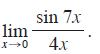
Find lim sin 7x 4.x
Differentiate y = (2x + 1)5(x3 – x + 1)4.
Find the points on the curve y = x4 – 6x2 + 4 where the tangent line is horizontal.
Find f'(x) if f(x) = In|x|.
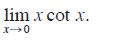
Calculate lim x cotx. X-0
Differentiate y = esin x.
The equation of motion of a particle is s = 2t3 – 5t2 + 3t + 4, where s is measured in centimeters and t in seconds. Find the acceleration as a function of time. What is the acceleration after 2 seconds?
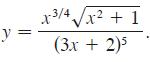
Differentiate y x3/4 √√x² + 1 (3x + 2)²
If f(x) = ex – x, find f' and f". Compare the graphs of f and f'.
Solve if f(x) = sin(cos(tan x)),
Differentiate y = x√x.
At what point on the curve y = ex is the tangent line parallel to the line y = 2x?
Differentiate y = esec 3θ
Prove that the equation x3 + x – 1 = 0 has exactly one real root.
Find where the function f(x) = 3x4 – 4x3 – 12x2 + 5 is increasing and where it is decreasing.
Find the critical numbers of f(x) = x3/5(4 – x).
Find In x lim x1 x 1 X- -
Showing 1100 - 1200
of 2680
First
5
6
7
8
9
10
11
12
13
14
15
16
17
18
19
Last
Step by Step Answers

 Get 50% OFF
Claim Now
Get 50% OFF
Claim Now



![[*] [0] = y](https://dsd5zvtm8ll6.cloudfront.net/images/question_images/1698/2/2/3/8806538d708272d21698223879829.jpg)





![(For instance, [4] = 4, [4.8] = 4, [] = 3, [2] = 1, [-] = 1.) -](https://dsd5zvtm8ll6.cloudfront.net/images/question_images/1698/5/0/5/242653d221a54eeb1698505242362.jpg)



![d dx [tanh (sin .x)].](https://dsd5zvtm8ll6.cloudfront.net/images/question_images/1698/7/3/3/51065409dc644d441698733507295.jpg)