New Semester
Started
Get
50% OFF
Study Help!
--h --m --s
Claim Now
Question Answers
Textbooks
Find textbooks, questions and answers
Oops, something went wrong!
Change your search query and then try again
S
Books
FREE
Study Help
Expert Questions
Accounting
General Management
Mathematics
Finance
Organizational Behaviour
Law
Physics
Operating System
Management Leadership
Sociology
Programming
Marketing
Database
Computer Network
Economics
Textbooks Solutions
Accounting
Managerial Accounting
Management Leadership
Cost Accounting
Statistics
Business Law
Corporate Finance
Finance
Economics
Auditing
Tutors
Online Tutors
Find a Tutor
Hire a Tutor
Become a Tutor
AI Tutor
AI Study Planner
NEW
Sell Books
Search
Search
Sign In
Register
study help
mathematics
introduction to the mathematics
A Concise Introduction To Pure Mathematics 4th Edition Martin Liebeck - Solutions
Cabs arrive to drop passengers off at an airport according to a Poisson process with rate 1 per minute. A cab can contain 1,2 , or 3 passengers with probabilities \(2 / 3,1 / 6\), and \(1 / 6\), respectively. The number of passengers in a cab is independent of the number in every other cab, and is
Customers arrive to a store according to a Poisson process with rate \(\lambda=10\) per hour. On average, one fourth of all customers buy something, and their decisions are made independently of other customers and of the arrival process. Find the expected number of purchases made during a 2-hour
Suppose that the number \(N_{t}\) of salmon that have passed a point on a river by time \(t\) forms a Poisson process with rate 2 per minute. The probability is \(1 / 4\) that a given salmon is over five pounds, and successive salmon weights are independent of one another. Show that the arrival
As illustrated in the diagram below, Wagner Ct. and Schneider Dr. are parallel one-way eastbound roads, and Scott Ave. is a one-way northbound road that terminates at Wagner. Cars arriving to intersection 1 on Wagner, intersection 2 on Schneider, and intersection 2 on Scott form Poisson processes
(a) Write a Mathematica command to simulate a desired number of arrival times \(T_{1}, T_{2}, \ldots\) of a Poisson process with a desired rate \(\lambda\). (b) Write a Mathematica command that accepts a list of arrival times and a particular time \(t\), and returns the value of \(N_{t}\).
Find all closed sets for the court case chain of Exercise 6, Section 4.3.
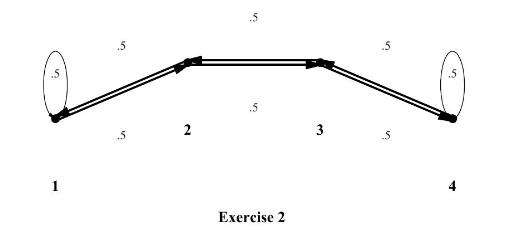
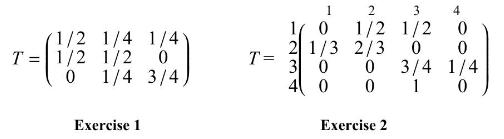
Find all irreducible sets of states for the chain with the transition diagram below. (The arrows represent all transitions that have non-zero probability.) Find the recurrence classes and the set of transient states. Exercise 2
Calculate the first four powers of the transition matrix \(T\) for the chain whose transition diagram is below. Is the graph a regular graph in the sense of Chapter 1? Is the chain irreducible? Can anything be said about the behavior of \(T^{n}\) as \(n \longrightarrow \infty\) ? Exercise 3 1/7/2
Find the recurrence classes and transient states of the chain whose transition matrix is below. 1/4 0 0 0 0 1/2 1/4 0 00100 0 0 0 0 1/200 0 0 10 0 0 0 1/3 0 0 0 2/3 0 1/4 0 0 0 1/4 1/2 0 1/2000 0 0 1/4 0 1/4 0 0 0 0 0 1/2 0 0 0 00 1/2 0 1/4 1/4, Exercise 5 0 1 0 0 3/4 0 1/4 0 000 0 000 0 0 0 0 0 0
Repeat Exercise 5 for the Markov chain with transition matrix above.
Show that if \(\left(X_{n}\right)\) is a Markov chain with finite state space \(E\) such that \(i \longrightarrow j\) for all states \(i\) and \(j\), and such that there exists a state \(i_{0}\) with \(T\left(i_{0}, i_{0}\right)>0\), then the chain is regular (i.e., it has a regular transition
Devise an example of a Markov chain with two absorbing states 1,2 and three transient states \(3,4,5\) in which the transient states have self-loops, and the probability that, starting from each transient state, the chain is eventually absorbed in state 1 is \(1 / 2\) and the probability that it is
In view of the recursive equation \(\mathbf{p}^{(n)}=\mathbf{p}^{(n-1)} \cdot T\) for the short-run distributions of a Markov chain, assuming that there is such a thing as a long-run or limiting distribution represented by a vector \(\mathbf{p}\), what equation should that vector satisfy? Check
For the chain of Exercise 6 of Section 4.4, whose transition matrix is reproduced below, find the limiting distribution \(\boldsymbol{\pi}\) within each recurrence class. 0 0 0 010 0 3/4 0 1/4 0 000 000 1000 0 0 0 0 0 1/2 2/3 1/3 0 0 1/2 0 0 0 1/3 000 000 0 0 0 0 0 000 0 0 1/3 1/3 010 000 0 0
Find the limiting distribution for the following random walk with "sticky barriers." S 5 S .5 2 3 Exercise 2 S
A company rents vans for personal moving. There are three districts from which vans can be rented, and to which they can be returned. The conditional probabilities that vans originating in each district are returned to each district are given in the table below. Find the long-run proportion of vans
For a general regular two-state Markov chain, find closed-form expressions for the limiting probabilities.
For the sales representative of Exercise 1 of Section 4.1, suppose that there are weekly travel expenses of \(\$ 500, \$ 600, \$ 700\), and \(\$ 800\) respectively, in the four regions. Find the long-run average weekly travel expense.
Two drill presses are under consideration by a manufacturer. If the first press works one day, then the probability is .9 that it will also work the next. If this press does not work one day, then it will be back in service on the next day with probability .7. For the other drill press, these two
Show that the system of equations \(\pi=\pi \cdot T\), where \(T\) is the transition matrix of a Markov chain, must have infinitely many solutions.
For the random walk with a reflecting barrier at 0 pictured below, write the stationary equations and verify that the vector \(\mathbf{0}\) is the only solution such that the sum of its components is bounded. 0 Exercise 9 .5
A college-owned van is used until it will not run anymore, and then it is immediately replaced by a similar new one whose lifetime \(Z\) has discrete distribution \(p_{1}=P[Z=1], p_{2}=P[Z=2], \ldots\), where the times are in months. The process continues through successive van replacements. Let
Let \(\left(X_{n}\right)\) be a finite, irreducible Markov chain with limiting distribution \(\pi\), and let \(f\) be a real-valued function on its state space. We think of \(f\left(X_{n}\right)\) as the reward earned at time \(n\). Use the Dominated Convergence Theorem (see Appendix A) to show
A substitute teacher must choose between two school systems. In the first, the probability that he will work on the next school day given that he worked today is \(2 / 3\). The probability that he will work on the next day given that he does not work today is \(1 / 4\). The corresponding
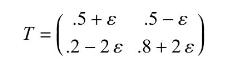
Let \(\left(X_{n}\right)\) be a two-state Markov chain over which we have a degree of control, in the sense that the transition matrix iswhere \(\varepsilon\) may be chosen from \([-.1, .1]\). If we receive a reward of \(\$ 2\) when state 1 is occupied, and \(\$ 1\) when state 2 is occupied, and
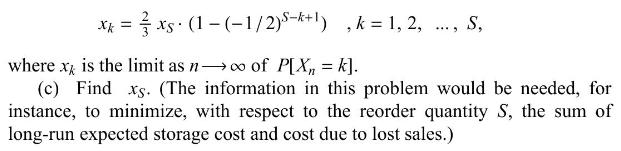
A store stocks an item, for which there is a random demand \(D\) each day. We suppose that demands on successive days are i.i.d. random variables with the discrete uniform distribution on \(\{0,1,2\}\). When the demand exceeds the stock, excess demand is lost. If there are no items left in stock at
A sales representative for a cosmetics firm makes calls in an area with four regions. If she is in region 1 this week, then she will be in region 2 with probability \(60 \%\), or region 4 with probability \(40 \%\), next week. If she is in region 2, then she goes to one of the other three regions
Compute, and interpret the meaning of, the row 1 , column 4 , entry of \(T^{2}\) for the transition matrix of the chain of Exercise 1.
An \(n \times n\) matrix is called a Markov matrix if its entries are non-negative and the sum of the entries in every single row is 1 . Thus, the transition matrix of a Markov chain is a Markov matrix. Show that the product of two Markov matrices is a Markov matrix.
A television manufacturer inspects the TV sets that it makes before releasing them for sale. The inspection of a set results in classification into one of four categories: poor condition (P), fair (F), good (G), or excellent condition (E). Sets in excellent condition are sent off for sale, while
Make up your own example of a Markov chain, and provide intuitive justification for the Markov property in Definition 1.
A model that is studied in theoretical computer science is the finite state automaton. This is a machine that reads input from a tape, one character at a time, and based on what it reads it moves from where it currently is to one of several other internal states. For instance, a machine that is
Write your own version of the SimDiscreteDist function described in the section.
Another problem that we will solve analytically later is the problem of finding the expected time that it takes a Markov chain to reach a state starting from another state. Consider the Markov chain with transition matrix and diagram below.Build a command to let you approximate the average number
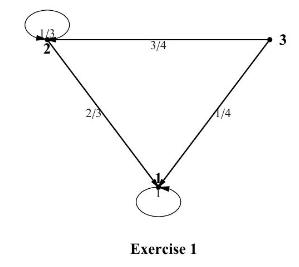
Consider the Markov chain whose transition diagram is below. Assume that it is certain that the chain begins in state 3.(a) Find the probability distribution of \(X_{2}\).(b) For arbitrary \(n\), find the distribution of \(X_{n}\). 2/3 3/4 3 Exercise 1 1/4
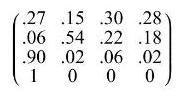
Consider the Markov chain with transition matrix below. Suppose the initial distribution is \(\mathbf{p}^{(0)}=(1 / 4,1 / 4,1 / 4,1 / 4)\). Find and interpret: (a) \(T^{3}(3,4)\); (b) \(\mathbf{p}^{(0)} \cdot T^{5}(3)\); (c) \(T^{n}(1,1)\). 7.27 .15 .30 .28 .06 .54 .22 .18 .90 .02 .06 .02 100 0
A random walk with reflecting barriers 0 and \(N\) is a Markov chain whose state space is \(E=\{0,1,2, \ldots, N\}\), which, at any state strictly between 0 and \(N\), moves next to either the state immediately to the left or immediately to the right with equal probability. If the chain is at state
Let \(\left(X_{n}\right)\) be an arbitrary two-state Markov chain with a transition matrix \(T\) whose every entry is non-zero. Find an expression for \(T^{n}\), and find the limit as \(n \longrightarrow \infty\) of \(T^{n}\).
For Example 4 of Section 4.1, the flu recovery model with \(N=5\), compute \(P\left[X_{3}=0 \mid X_{0}=5\right]\) and \(P\left[X_{2}=1, X_{3}=0 \mid X_{0}=5\right]\).
A Markov chain of three states has the transition matrix below. Draw a tree diagram representing the first three transitions of the chain, in which each state has a directed edge pointing to the possible next states, weighted by the probabilities of visiting those states. Use this tree to find
A machine can either be in excellent, good, fair, or poor working condition at each time. Given that its current condition is any of the first three, it can be in either the same condition next time with probability .95 , or in a condition that is one level worse with the remaining probability.
A program vehicle is used by a car dealer until it reaches the end of its useful lifetime, and then is immediately replaced by a similar vehicle. It is reasonable to suppose that the successive lifetimes \(Z_{1}, Z_{2}, Z_{3}, \ldots\) of these vehicles are i.i.d. with some discrete distribution:
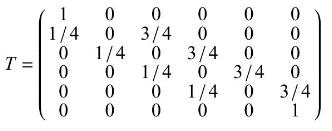
Consider the Markov chain with the transition matrix below. Investigate the behavior of \(T^{n}\) for large \(n\), and interpret it in terms of the geometry of the transition diagram. 1 0 0 0 0 0 1/4 0 3/4 0 0 0 0 1/4 0 3/4 0 0 T = 0 0 1/4 0 3/4 0 0 0 0 1/4 0 3/4 0 0 0 0 0 1
Find \(F_{k}(3,1)\) for all \(k \geq 1\) for the frozen food companies of Example 2, Section 4.1. For your convenience, the transition matrix of the chain is reproduced below. 1/2 1/4 1/4 T1/2 1/2 0 0 1/4 3/4 Exercise 1 1 2 3 10 1/2 1/2 4 0 0 0 2 1/3 2/3 T= 3 0 0 40 3/4 1/4 0 1 0 Exercise 2
For the Markov chain of Figure 4.2, whose transition matrix is above, compute \(F_{k}(1,3)\) for \(k=1,2,3,4,5\).
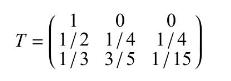
Let \(\left(X_{n}\right)\) be the chain with transition matrix below. Find \(F_{k}(i, 2)\) for \(i=1,2,3\) and all \(k=1,2,3, \ldots\). 1 0 0 T=1/2 1/4 1/4 1/3 3/5 1/15,
Write a Mathematica program to compute the vector \(\mathbf{F}_{k}(i, j)\) (as \(i\) ranges through the state space) given \(j\) and the transition matrix \(T\).
Compute the distribution of the time of first passage of a television set from the fair state to the excellent state for the chain of Exercise 4 of Section 4.1. (Note that it is possible for this time to be \(+\infty\).)
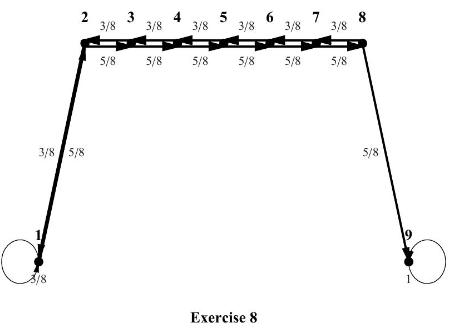
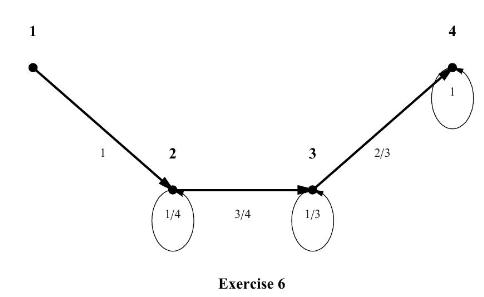
A judicial case can be heard at three levels: lower court (1), appellate court (2), and high court (3). State 4 in the transition diagram below represents final termination of the case. The weights in the directed graph are the probabilities that the case will move from one court to another, e.g.,
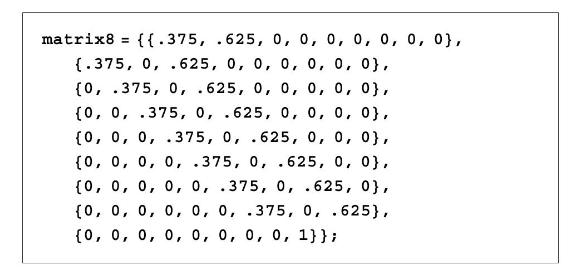
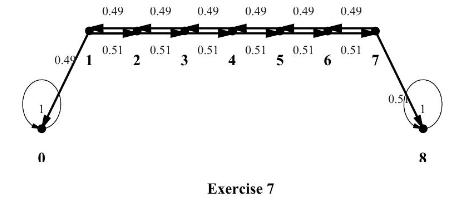
A game is played so that the wealth of the gambler at each play either rises by 1 with probability .51 or falls by 1 with probability .49 , until the wealth either hits 0 or 8 , at which point the game stops. For each interior state \(1,2, \ldots, 7\) in the transition diagram below, find the
In Exercise 6, the time of first visit from state 3 to state 4 has a geometric distribution with success parameter \(2 / 3\), so that \(E\left[T_{4} \mid X_{0}=3\right]=3 / 2\). Find \(E\left[T_{4} \mid X_{0}=2\right]\) without finding the conditional distribution of \(T_{4}\) given \(X_{0}=2\).
For a general two-state Markov chain with all transition probabilities non-zero, find expressions for \(F_{k}(1,2)\) and \(F_{k}(2,1)\).
Verify formula (11) for the expected time to reach the healthy state in the flu model.
For a general three-state Markov chain in which state 1 is an absorbing state, find formulas for \(F_{k}(i, j)\) for all pairs of states \(i, j=2,3\). What is \(F_{k}(1, j)\) for \(j=2,3\) ? Set up, but do not attempt to solve, equations for \(F_{k}(2,1)\) and \(F_{k}(3,1)\).
For a cyclic Markov chain with five states, that is, a chain in which state 1 must go to state 2 , state 2 must go to state 3 , etc., what does formula (2) reduce to? Find all first passage time probabilities \(F_{k}(i, j)\).
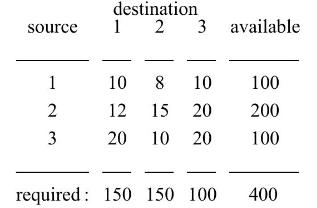
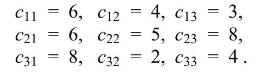
Solve the transportation problem with 3 sources and 3 destinations whose cost structure and supply and demand requirements are in the table below. (The table entries are costs per unit shipped.) source 1 2 3 destination 1 2 3 3 available 110 8 110 12 15 20 100 200 20 10 20 100 required 150 150 100
A manufacturer of auto batteries has two plants, which are to supply four retailers. The plants have 1000 and 1500 batteries available, respectively. The four retailers have ordered \(800,500,400\), and 800 batteries, respectively. The shipping costs, in cents per battery, from plant 1 to the four
Prove that, in reference to the Transportation Phase 1 algorithm, if a variable is currently undeclared in step 2a, then it appears with its original coefficient in exactly one unused supply and exactly one unused demand equation.
Prove that if the entries in any single row or column of the cost matrix \(\left(c_{i j}\right)\) of a transportation problem are all reduced by the same number, then the optimal solution does not change.
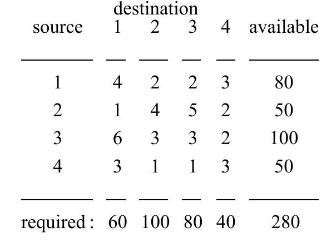
Solve the transportation problem whose supply and demand requirements, and transportation costs are given in the table below. source destination 1 2 3 4 available 1 4 2 2 3 80 2 1 3 6 + m 4 5 2 50 3 3 2 100 4 3 1 1 3 50 required: 60 100 80 40 280
Prove that under the assumptions of this section, Phase 1 of the Transportation Algorithm must result in an integer-valued feasible solution.
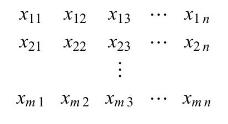
One alternative to the minimum cost selection rule for the transportation algorithm is the Northwest Corner Rule. In this approach, the chosen sequence of basic variables is simpler. Display the variables \(x_{i j}\) in an array as shown below:First let \(x_{11}\) be basic (i.e., begin in the
Redo Example 2 using the Northwest Corner Algorithm (see Exercise 7).
Suppose that in Exercise 1, source 1 can only supply 90 items. Execute the Transportation Algorithm on the resulting problem, and explain what happens in the final system or tableau. (This time, do not discard an equation when it is the only one still unused in its group.)
Suppose that in Exercise 1, source 1 can now supply 110 items. As in Exercise 9, execute Phase 1 of the Transportation Algorithm and explain the result.
Consider a step in the Transportation Algorithm in which there remains exactly one supply constraint that has no basic variable corresponding to it, and there are two or more unused demand constraints. Show that it cannot be the case that when a new basic variable is selected, the final supply
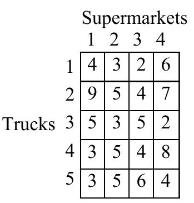
Use the tableau version of the Transportation Phase 1 algorithm, and if necessary the Phase 2 simplex algorithm, to solve the following problem. A bakery has five trucks servicing the four supermarkets in a town. The trucks contain \(10,8,7,10\), and 6 units of bread, respectively, and the
We may view the optimal assignment problem of Chapter 1 as a transportation problem in the following way. Let a variable \(x_{i j}\) equal 1 if worker \(i\) is assigned to task \(j\), and 0 otherwise. There is a cost \(c_{i j}\) of assigning worker \(i\) to task \(j\).(a) Formulate an objective
Referring to the discussion of Exercise 13, solve Exercise 12 of Section 6 of Chapter 1 using the Transportation Algorithm.
Check that the winery problem can be decomposed as in formula (4).
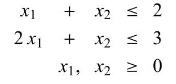
Express the LP problem of Example 2 of Chapter 2, Section 3 in the form (4). (For your convenience, we were to maximize \(f=4 x_{1}+2 x_{2}\) subject to the constraints below.) X1 2x1 + x2 2 + x2 3 X1, X2 0
We return to the coal mining example, which is Example 4 of Chapter 2, Section 3.(a) Identify the vectors \(\mathbf{b}^{*}\) and \(\mathbf{c}^{*}\) and the matrix \(S\) of Figure 3.5 for this problem.(b) Express the problem in the form of formula (4).(c) Verify the equations in parts (b) and (c) of
For Example 4 of Chapter 2, Section 3:(a) Find the range of values of each component of a perturbation vector \(\Delta \mathbf{c}=\left(\Delta_{1}, \Delta_{2}\right)\) such that the basic solution depicted in the final tableau is still optimal.(b) Sketch the set of all pairs \(\left(\Delta_{1},
Prove that the non-basic variable columns of the matrix \(A^{*}\) of Figure 3.5 (b) are the corresponding columns of \(S \cdot N\).
In Example 2, sketch the regions in the:(a) \(\Delta_{1}-\Delta_{2}\) plane;(b) \(\Delta_{2}-\Delta_{3}\) plane; and(c) \(\Delta_{1}-\Delta_{3}\) plane, such that the optimal solution of the original problem remains optimal when the given pair of perturbations is imposed, holding the remaining
Consider Exercise 4 of Chapter 2, Section 3 involving the farmer and his hogs, chickens, and ostriches.(a) Find a system of inequalities characterizing the set of all perturbation vectors \(\Delta \mathbf{b}=\left(\Delta_{1}, \Delta_{2}\right)\) for \(\mathbf{b}\) such that the optimal solution
(a) Find the new optimal tableau for the winery problem if the constraint constant vector is perturbed by a vector \(\Delta \mathbf{b}\) whose components are: \(\Delta_{1}=-75, \Delta_{2}=4, \Delta_{3}=16\), and \(\Delta_{4}=91 / 2\).(b) For fixed \(\Delta_{1}=-75, \Delta_{4}=-21 / 2\), graph the
Show in general the observation that was made in Example 3.That is, prove that the negatives of the slack variable coefficients in the objective row of a final simplex system (the optimal values of the dual variables) are the same as the coefficients of \(\Delta_{1}, \Delta_{2}, \ldots,
In Example 4 on the winery, find a system of inequalities for the perturbations \(\Delta_{1}, \Delta_{2}, \Delta_{3}\), and \(\Delta_{4}\) of the red wine column of constraint coefficients to characterize the set of such perturbations under which the current solution is still optimal.
Consider Exercise 1 of Chapter 2, Section 1 on allocation of city funds for the purchase of two types of vehicles. Suppose that the purchase price of vans is incremented by an amount \(\Delta_{1}\), and the maintenance cost per year for a van is changed by an amount \(\Delta_{2}\). Characterize the
This problem refers to Example 3 of Chapter 2, Section 3, which is repeated below.(a) Find the set of perturbations of the form \((\Delta, \Delta, \Delta)\) to the column of \(x_{1}\) constraint coefficients that do not change the optimal solution.(b) If \(\Delta=-2\), find the resulting perturbed
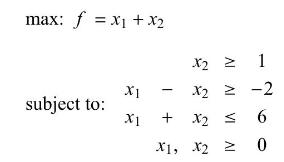
Solve the non-standard problem: max: x1+x2 subject to: X1 - X1 X2 X2 + x2 X2 -260 X1, X2 0
What happens in Phase 1 of the investment problem of Example 2 if the first entering basic variable is chosen to be \(x_{1}\) instead of \(x_{3}\) ? Do you get the same basic feasible solution at the start of Phase 2 ?
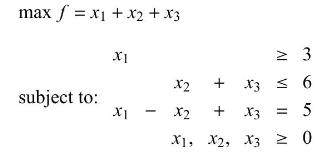
Find the optimal solution of: max x1+x2 + x3 subject to: X1 IV 3 X2 + X3 6 X1 - X2 + X3 = 5 X1, X2, X3 0
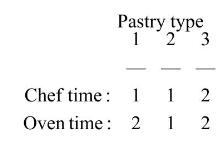
A bakery employs a skilled pastry chef, who should work at least 6 hours per day. An oven suitable for the use of the chef is available 8 hours per day. Three types of pastry are to be made; each batch requires labor time (in hours) by the chef and time in the oven as below:Suppose that the profit
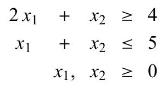
Find the minimum value of \(2 x_{1}-x_{2}\) subject to 2x1 + x2 4 X1 + X2 5 X1, X2 0
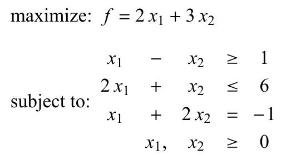
Solve the following non-standard problem without recourse to the simplex algorithm. maximize: 2x1 + 3x2 X1 subject to: X2 1 2.x1 + X2 6 x1 + 2x2 -1 X1, X2 0
Show the converse of Theorem 2(b); i.e., show that if problem (LP1) is infeasible, then the optimum value of problem (LP2) is strictly less than zero.
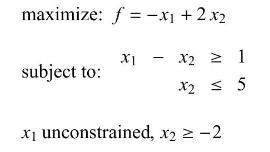
Express the following problem in non-standard form with all variables constrained to be non-negative. Then solve the problem by the Phase 1-Phase 2 approach. Sketch the feasible region. maximize: f-x+2x2 X1 - x2 1 X2 subject to: x2 5 x unconstrained, x2 -2
A woman beginning a small business will borrow \(\$ 10,000\). There are three possible lenders; one is an in-town bank who charges an effective annual interest rate of \(10 \%\), the second is a savings and loan whose interest rate is \(8 \%\), and the third is a major out-of-town bank, whose
There is an alternative method for solving problems with mixed inequality constraints, which can result in computational savings, called the "Big M" method. Instead of introducing an artificial variable into every constraint asPhase 1 does, introduce it only into the " \(\geq\) " constraints, i.e.,
A maker of bird seed will use three ingredients, labeled A, B, and C, to form boxes of exactly 100 grams of seed. It has been determined that the profit per gram of \(\mathrm{A}\) is 5 , and the profits per gram of \(\mathrm{B}\) and \(\mathrm{C}\) are 4 each. It is desired to achieve a threshhold
Formulate as a non-standard linear program, but do not solve, the maximal flow problem of Example 2 of Section 1.5 .
By producing suitable examples of relations, show that it is not possible to deduce any one of the properties of being reflexive, symmetric or transitive from the other two.
Prove that if \(S\) is a set and \(S_{1}, \ldots, S_{k}\) is a partition of \(S\), then there is a unique equivalence relation \(\sim\) on \(S\) that has the \(S_{i}\) as its equivalence classes.
(a) How many relations are there on the set \(\{1,2\}\) ?(b) How many relations are there on the set \(\{1,2,3\}\) that are both reflexive and symmetric?(c) How many relations are there on the set \(\{1,2, \ldots, n\}\) ?
Let \(S=\{1,2,3,4\}\), and suppose that \(\sim\) is an equivalence relation on \(S\). You are given the information that \(1 \sim 2\) and \(2 \sim 3\).Show that there are exactly two possibilities for the relation \(\sim\), and describe both (i.e., for all \(a, b \in S\), say whether or not \(a
Let \(\sim\) be an equivalence relation on \(\mathbb{Z}\) with the property that for all \(m \in \mathbb{Z}\) we have \(m \sim m+5\) and also \(m \sim m+8\). Prove that \(m \sim n\) for all \(m, n \in \mathbb{Z}\).
Critic Ivor Smallbrain has made his peace with rival Greta Picture, and they are now friends. Possibly their friendship will develop into something even more beautiful, who knows. Ivor and Greta are sitting through a showing of the latest Disney film, 101 Equivalence Relations. They are fed up and
Find the primes \(p\) and \(q\), given that \(p q=18779\) and \((p-1)(q-1)=\) 18480.
Showing 200 - 300
of 575
1
2
3
4
5
6
Step by Step Answers

 Get 50% OFF
Claim Now
Get 50% OFF
Claim Now