New Semester
Started
Get
50% OFF
Study Help!
--h --m --s
Claim Now
Question Answers
Textbooks
Find textbooks, questions and answers
Oops, something went wrong!
Change your search query and then try again
S
Books
FREE
Study Help
Expert Questions
Accounting
General Management
Mathematics
Finance
Organizational Behaviour
Law
Physics
Operating System
Management Leadership
Sociology
Programming
Marketing
Database
Computer Network
Economics
Textbooks Solutions
Accounting
Managerial Accounting
Management Leadership
Cost Accounting
Statistics
Business Law
Corporate Finance
Finance
Economics
Auditing
Tutors
Online Tutors
Find a Tutor
Hire a Tutor
Become a Tutor
AI Tutor
AI Study Planner
NEW
Sell Books
Search
Search
Sign In
Register
study help
mathematics
precalculus
Precalculus 9th edition Michael Sullivan - Solutions
In problem, use transformations to graph each function. Determine the domain, range, and horizontal asymptote of each function.f(x) = -3x + 1
A business purchased for $650,000 in 2005 is sold in 2008 for $850,000. What is the annual rate of return for this investment?
In problem, find the domain of each function.g(x) = 1/ln x
Solve exponential equation. Express irrational solutions in exact form and as a decimal rounded to three decimal places.π1-x = ex
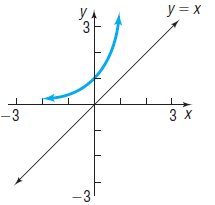
In problem, the graph of a one-to-one function f is given. Draw the graph of the inverse function f-1. For convenience (and as a hint), the graph of y = x is also given. У %3Dх -3 3х -3
In problem, use transformations to graph each function. Determine the domain, range, and horizontal asymptote of each function.f(x) = 3-x - 2
George contemplates the purchase of 100 shares of a stock selling for $15 per share. The stock pays no dividends. The history of the stock indicates that it should grow at an annual rate of 15% per year.How much should the 100 shares of stock be worth in 5 years?
In problem, find the domain of each function.f(x) = √ln x
Solve exponential equation. Express irrational solutions in exact form and as a decimal rounded to three decimal places.0.31+x = 1.72x-1
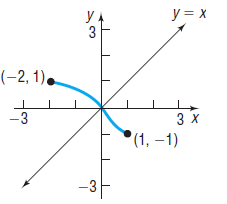
The graph of a one-to-one function f is given. Draw the graph of the inverse function f-1. For convenience (and as a hint), the graph of y = x is also given. y = x У 3 (-2, 1). 3 x (1, -1) -3 -3F
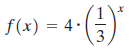
Use transformations to graph each function. Determine the domain, range, and horizontal asymptote of each function. f(x) = 4. (3) X
John requires $3000 in 6 months to pay off a loan that has no prepayment privileges. If he has the $3000 now, how much of it should he save in an account paying 3% compounded monthly so that in 6 months he will have exactly $3000?
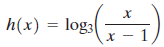
Find the domain of each function. h(x) = log3 X x-1
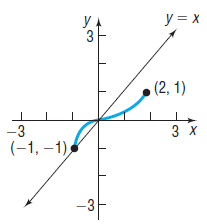
The graph of a one-to-one function f is given. Draw the graph of the inverse function f-1. For convenience (and as a hint), the graph of y = x is also given. У %3Dх y 3 (2, 1) -3 3х (-1, –1), -3
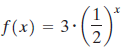
Use transformations to graph each function. Determine the domain, range, and horizontal asymptote of each function. (-/-)* f(x) = 3.
Jerome will be buying a used car for $15,000 in 3 years. How much money should he ask his parents for now so that, if he invests it at 5% compounded continuously, he will have enough to buy the car?
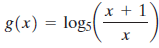
Find the domain of each function. g(x) = logs x + 1 X
Solve exponential equation. Express irrational solutions in exact form and as a decimal rounded to three decimal places.(4/3)1-x = 5x
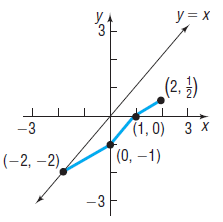
The graph of a one-to-one function f is given. Draw the graph of the inverse function f-1. For convenience (and as a hint), the graph of y = x is also given. (2. }) (1, 0) 3 x -3 (0, –1) (-2, –2). -3F
For the given functions f and g, find:a. f ° gb. g ° fc. f ° fd. g ° g 2х — 1 f(x) = 2х — х+4 8(х) Г). 2х — 5 х — 2°
Use transformations to graph each function. Determine the domain, range, and horizontal asymptote of each function.f(x) = 2x+2
A department store charges 1.25% per month on the unpaid balance for customers with charge accounts (interest is compounded monthly). A customer charges $200 and does not pay her bill for 6 months.What is the bill at that time?
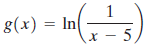
Find the domain of each function. g(x) = In 1 x-5
Solve exponential equation. Express irrational solutions in exact form and as a decimal rounded to three decimal places.(3/5)x = 71-x
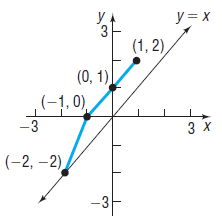
In problem, the graph of a one-to-one function f is given. Draw the graph of the inverse function f-1. For convenience (and as a hint), the graph of y = x is also given. у 3х (1, 2), (0, 1) (-1, 0). 1,0) -3 3х (-2, –2) -3-
For the given functions f and g, find:a. f ° gb. g ° fc. f ° fd. g ° g g(x) f(x) x + 1'
What will a $90,000 condominium cost 5 years from now if the price appreciation for condos over that period averages 3% compounded annually?
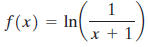
Find the domain of each function. f(x) = In( x + 1 f(x)
Solve exponential equation. Express irrational solutions in exact form and as a decimal rounded to three decimal places.2x+1 = 51-2x
In problem, verify that the functions f and g are inverses of each other by showing that f(g(x)) = x and g(f(x)) = x. Give any values of x that need to be excluded from the domain of f and the domain of g. х — 5 f(x) 8(x) Зх + 5 1 - 2x 2x + 3'
In problem, use transformations to graph each function. Determine the domain, range, and horizontal asymptote of each function.f(x) = 3 x – 2
How many years will it take for an initial investment of $25,000 to grow to $80,000? Assume a rate of interest of 7% compounded continuously.
In problem, find the domain of each function.g(x) = 8 + 5 ln(2x + 3)
In problem, solve each exponential equation. Express irrational solutions in exact form and as a decimal rounded to three decimal places.31-2x = 4x
In problem, for the given functions f and g, find:a. f ° gb. g ° fc. f ° fd. g ° gf(x) = x2 + 1; g(x) = √x – 1
In problem, verify that the functions f and g are inverses of each other by showing that f(g(x)) = x and g(f(x)) = x. Give any values of x that need to be excluded from the domain of f and the domain of g. 2x + 3 4x - 3 f(x) = ; 8(x) x + 4 2 - x
In problem, use transformations to graph each function. Determine the domain, range, and horizontal asymptote of each function.f(x) = 2x + 1
How many years will it take for an initial investment of $10,000 to grow to $25,000? Assume a rate of interest of 6% compounded continuously.
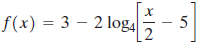
In problem, find the domain of each function. f(x) = 3 – 2log, 5
In problem, solve each exponential equation. Express irrational solutions in exact form and as a decimal rounded to three decimal places.0.3(40.2x) = 0.2
In problem, for the given functions f and g, find:a. f ° gb. g ° fc. f ° fd. g ° gf(x) = √x - 2; g(x) = 1 - 2x
If Angela has $100 to invest at 10% per annum compounded monthly, how long will it be before she has $175? If the compounding is continuous, how long will it be?
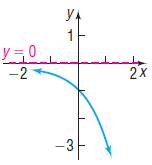
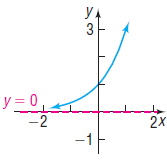
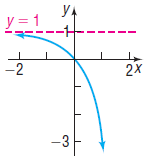
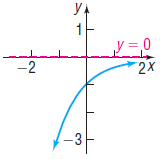
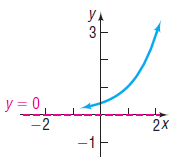
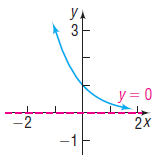
In problem, the graph of an exponential function is given. Match each graph to one of the following functions(a) y = 3x(b) y = 3-x(c) y = -3x(d) y = -3-x(e) y = 3x - 1(f) y = 3x-1(g) y = 31 €“ x(h) y = 1 - 3x 3 -2 2x -1
In problem, find the domain of each function.H(x) = log5 x3
In problem, solve each exponential equation. Express irrational solutions in exact form and as a decimal rounded to three decimal places.5(23x) = 8
In problem, for the given functions f and g, find:a. f ° gb. g ° fc. f ° fd. g ° gf(x) = -√x; g(x) = 2x + 3
In problem, verify that the functions f and g are inverses of each other by showing that f(g(x)) = x and g(f(x)) = x. Give any values of x that need to be excluded from the domain of f and the domain of g. f(x) = g(x)
If Tanisha has $100 to invest at 8% per annum compounded monthly, how long will it be before she has $150? If the compounding is continuous, how long will it be?
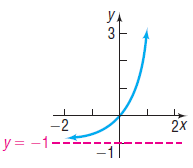
In problem, the graph of an exponential function is given. Match each graph to one of the following functions(a) y = 3x(b) y = 3-x(c) y = -3x(d) y = -3-x(e) y = 3x - 1(f) y = 3x-1(g) y = 31 €“ x(h) y = 1 - 3x УА 3 -2 y = -1-- 2х
In problem, find the domain of each function.F(x) = log2 x2
In problem, solve each exponential equation. Express irrational solutions in exact form and as a decimal rounded to three decimal places.2-x = 1.5
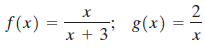
In problem, for the given functions f and g, find:a. f ° gb. g ° fc. f ° fd. g ° g f(x) x + 3' 8(x) 2
In problem, verify that the functions f and g are inverses of each other by showing that f(g(x)) = x and g(f(x)) = x. Give any values of x that need to be excluded from the domain of f and the domain of g. f(x) = (x – 2)², x > 2; g(x) = Vĩ + 2
What rate of interest compounded continuously will yield an effective interest rate of 6%?
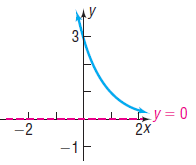
In problem, the graph of an exponential function is given. Match each graph to one of the following functions(a) y = 3x(b) y = 3-x(c) y = -3x(d) y = -3-x(e) y = 3x - 1(f) y = 3x-1(g) y = 31 €“ x(h) y = 1 - 3x Уд y=0 -2 -3
In problem, solve each exponential equation. Express irrational solutions in exact form and as a decimal rounded to three decimal places.8-x = 1.2
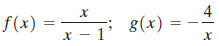
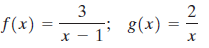
In problem, for the given functions f and g, find:a. f ° gb. g ° fc. f ° fd. g ° g 4 8(x) x – 1' f(x)
In problem, verify that the functions f and g are inverses of each other by showing that f(g(x)) = x and g(f(x)) = x. Give any values of x that need to be excluded from the domain of f and the domain of g. f(x) = x³ – 8; g(x) g(x) = Vx + 8
In problem, evaluate each expression. Do not use a calculator.2log20.4
In problem, find the domain of each function.g(x) = ln(x - 1)
In problem, find the exact value of each logarithm without using a calculator.ln√e
In problem, use the given function f to:(a) Find the domain of f.(b) Graph f.(c) From the graph, determine the range and any asymptotes of f.(d) Find f-1, the inverse of f.(e) Find the domain and the range of f-1.(f) Graph f-1.f(x) = 4x+1 - 2
What rate of interest compounded quarterly will yield an effective interest rate of 7%?
In problem, the graph of an exponential function is given. Match each graph to one of the following functions(a) y = 3x(b) y = 3-x(c) y = -3x(d) y = -3-x(e) y = 3x - 1(f) y = 3x-1(g) y = 31 €“ x(h) y = 1 - 3x УА 3 y = 0, -2 2x -1
In problem, find the domain of each function.f(x) = In(x - 3)
In problem, solve each exponential equation. Express irrational solutions in exact form and as a decimal rounded to three decimal places.3x = 14
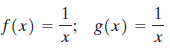
In problem, for the given functions f and g, find:a. f ° gb. g ° fc. f ° fd. g ° g f(x) = g(x) x + 3'
In problem, verify that the functions f and g are inverses of each other by showing that f(g(x)) = x and g(f(x)) = x. Give any values of x that need to be excluded from the domain of f and the domain of g. f(x) = 2x + 6; g(x) = x – 3 -X - 3
In problem, evaluate each expression. Do not use a calculator.eln0.1
(a) How long does it take for an investment to triple in value if it is invested at 6% compounded monthly?(b) How long does it take if the interest is compounded continuously?
In problem, the graph of an exponential function is given. Match each graph to one of the following functions(a) y = 3x(b) y = 3-x(c) y = -3x(d) y = -3-x(e) y = 3x - 1(f) y = 3x-1(g) y = 31 €“ x(h) y = 1 - 3x ул y = 1 -2 2X -3
In problem, find the exact value of each logarithm without using a calculator.ln e3
In problem, solve each exponential equation. Express irrational solutions in exact form and as a decimal rounded to three decimal places.2x = 10
In problem, for the given functions f and g, find:a. f ° gb. g ° fc. f ° fd. g ° g 2 8(x) 3 f(x)
In problem, verify that the functions f and g are inverses of each other by showing that f(g(x)) = x and g(f(x)) = x. Give any values of x that need to be excluded from the domain of f and the domain of g. f(x) = 4x – 8; g(x) + 2 4
In problem, evaluate each expression. Do not use a calculator.ln e√2
In problem, the graph of an exponential function is given. Match each graph to one of the following functions(a) y = 3x(b) y = 3-x(c) y = -3x(d) y = -3-x(e) y = 3x - 1(f) y = 3x-1(g) y = 31 €“ x(h) y = 1 - 3x y. y =0 2X -2 -3-
Find the effective rate of interest.(a) How long does it take for an investment to double in value if it is invested at 8% compounded monthly?(b) How long does it take if the interest is compounded continuously?
In problem, solve each exponential equation. Express irrational solutions in exact form and as a decimal rounded to three decimal places.5-x = 25
In problem, for the given functions f and g, find:a. f ° gb. g ° fc. f ° fd. g ° gf(x) = x2 + 1; g(x) = 2x2 + 3
In problem, verify that the functions f and g are inverses of each other by showing that f(g(x)) = x and g(f(x)) = x. Give any values of x that need to be excluded from the domain of f and the domain of g. |f(x) = 3 – 2x; g(x) = z(x – 3)|
In problem, evaluate each expression. Do not use a calculator.log3 81
In problem, the graph of an exponential function is given. Match each graph to one of the following functions(a) y = 3x(b) y = 3-x(c) y = -3x(d) y = -3-x(e) y = 3x - 1(f) y = 3x-1(g) y = 31 €“ x(h) y = 1 - 3x УА 3 =0 y : -2 -1F 2х
What rate of interest compounded annually is required to triple an investment in 10 years?
In problem, find the exact value of each logarithm without using a calculator.log√3 9
In problem, find the exact value of each logarithm without using a calculator.log√2 4
In problem, solve each exponential equation. Express irrational solutions in exact form and as a decimal rounded to three decimal places.2x-5 = 8
In problem, for the given functions f and g, find:a. f ° gb. g ° fc. f ° fd. g ° gf(x) = x2; g(x) = x2 + 4
In problem, verify that the functions f and g are inverses of each other by showing that f(g(x)) = x and g(f(x)) = x. Give any values of x that need to be excluded from the domain of f and the domain of g. (x – 4) f(x) = 3x + 4; g(x) %3D
In problem, the graph of an exponential function is given. Match each graph to one of the following functions(a) y = 3x(b) y = 3-x(c) y = -3x(d) y = -3-x(e) y = 3x - 1(f) y = 3x-1(g) y = 31 €“ x(h) y = 1 - 3x УА 3 y = 0 -2 2X -1
What rate of interest compounded annually is required to triple an investment in 5 years?
In problem, find the exact value of each logarithm without using a calculator.log5 3√25
In problem, for the given functions f and g, find:a. f ° gb. g ° fc. f ° fd. g ° gf(x) = x + 1; g(x) = x2 + 4
In problem, find the inverse of each one-to-one function. State the domain and the range of each inverse function.{(-2, -8), (-1, -1), (0, 0), (1, 1), (2, 8)}
In problem, solve each logarithmic equation. Express irrational solutions in exact form and as a decimal rounded to three decimal places.loga x + loga (x - 2) = loga (x + 4)
In problem, find the domain of each logarithmic function.F(x) = ln(x2 - 9)
In problem, determine whether the given function is linear, exponential, or neither. For those that are linear functions, find a linear function that models the data; for those that are exponential, find an exponential function that models the data.x ……………………….. F(x)-1
What rate of interest compounded annually is required to double an investment in 6 years?
In problem, find the exact value of each logarithm without using a calculator.log10 √10
In problem, for the given functions f and g, find:a. f ° gb. g ° fc. f ° fd. g ° gf(x) = 3x + 1; g(x) = x2
Showing 26700 - 26800
of 29454
First
261
262
263
264
265
266
267
268
269
270
271
272
273
274
275
Last
Step by Step Answers

 Get 50% OFF
Claim Now
Get 50% OFF
Claim Now