







Question: In Example 6.7 evaluate (bar{C}_{1}, bar{C}_{2}, phi_{1}), and (phi_{2}) using the given initial conditions: (x_{1}(0)=1 mathrm{~cm}, x_{2}(0)=) (-1 mathrm{~cm}, dot{x}_{1}(0)=3 mathrm{~cm} / mathrm{s}, dot{x}_{2}(0)=-2 mathrm{~cm}
In Example 6.7 evaluate \(\bar{C}_{1}, \bar{C}_{2}, \phi_{1}\), and \(\phi_{2}\) using the given initial conditions: \(x_{1}(0)=1 \mathrm{~cm}, x_{2}(0)=\) \(-1 \mathrm{~cm}, \dot{x}_{1}(0)=3 \mathrm{~cm} / \mathrm{s}, \dot{x}_{2}(0)=-2 \mathrm{~cm} / \mathrm{s}\). Use \(\sqrt{k / m}=10 \mathrm{rad} / \mathrm{s}\).
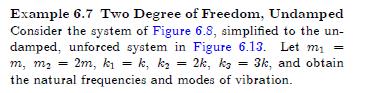
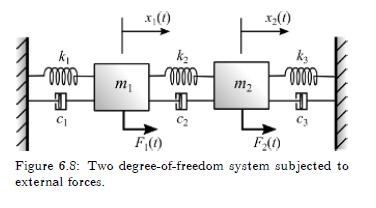
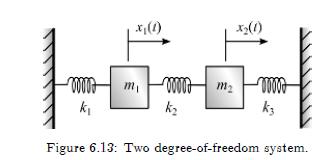
Example 6.7 Two Degree of Freedom, Undamped Consider the system of Figure 6.8, simplified to the un- damped, unforced system in Figure 6.13. Let m = m, m = 2m, k =k, k = 2k, kg = 3k, and obtain the natural frequencies and modes of vibration.
Step by Step Solution
★★★★★
3.34 Rating (151 Votes )
There are 3 Steps involved in it
1 Expert Approved Answer
Step: 1 Unlock

Question Has Been Solved by an Expert!
Get step-by-step solutions from verified subject matter experts
Step: 2 Unlock
Step: 3 Unlock
 Study Help