







Question: (a) Write down the explicit form of the Langevin equation for the x component of velocity v(t) of a dust particle interacting with thermalized air
(a) Write down the explicit form of the Langevin equation for the x component of velocity v(t) of a dust particle interacting with thermalized air molecules.
(b) Suppose that the dust particle has velocity v at time t. By integrating the Langevin equation, show that its velocity at time t + △t is v + △v, where
![mAv + RvAt +O[(At)] = ct+At F'(t')dt', (6.103a)](https://dsd5zvtm8ll6.cloudfront.net/si.experts.images/questions/2023/04/644e3ff981fbe_785644e3ff92107c.jpg)
with R the frictional resistance and m the particle’s mass. Take an ensemble average of this and use F̅’ = 0 to conclude that the function A(v) appearing in the Fokker-Planck equation (6.94) has the form

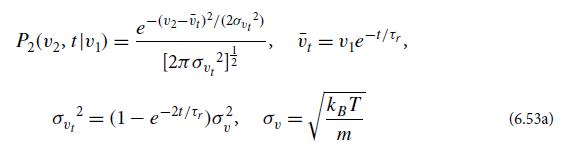
Compare this expression with the first of Eqs. (6.101) to conclude that the mean and relaxation time are v̅ = 0 and τr = m/R, respectively, in agreement with the second of Eqs. (6.53a) in the limit τ →∞and with Eq. (6.78).
(c) From Eq. (6.103a) show that

Take an ensemble average of this expression, and use

with the Wiener-Khintchine theorem—to evaluate the terms involving F' in terms of SF', which in turn is known from the fluctuation-dissipation theorem. Thereby obtain

Combine with Eq. (6.101) and τr = m/R [from part (b)], to conclude that σv2= kBT/m, in accord with the last of Eqs. (6.53a).
Equations



mAv + RvAt +O[(At)] = ct+At F'(t')dt', (6.103a)
Step by Step Solution
3.51 Rating (168 Votes )
There are 3 Steps involved in it
a The Langevin equation for the x component of velocity vt of a dust particle interacting with ther... View full answer

Get step-by-step solutions from verified subject matter experts
 Study Help