







Question: Consider a plane, monochromatic electromagnetic wave with angular frequency , whose electric field is expressed in terms of its complex amplitude X 1 + iX
Consider a plane, monochromatic electromagnetic wave with angular frequency ω, whose electric field is expressed in terms of its complex amplitude X1 + iX by Eq. (10.58). Because the field (inevitably) is noisy, its quadrature amplitudes X1 and X2 are random processes with means X̅1, X̅2 and variances △X1, △X2.
(a) Normal, classical light has equal amounts of noise in its two quadratures. Explain why it can be represented by Fig. 10.14a.
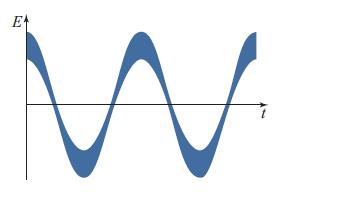
(b) Explain why Fig. 10.14b represents phase-squeezed light, and show that its electric field as a function of time has the form shown in Fig. 10.15.
(c) Explain why Fig. 10.14c represents amplitude-squeezed light, and construct a diagram of its electric field as a function of time analogous to Fig. 10.15.
(d) Figure 10.14d represents the vacuum state of light’s frequency-ω plane-wave mode. Give a formula for the diameter of the mode’s circular error box. Construct a diagram of the electric field as a function of time analogous to Fig. 10.15.
(e) Figure 10.14e represents the squeezed vacuum. Construct a diagram of its electric field as a function of time analogous to Fig. 10.15.
Eq. (10.58).

Fig. 10.14
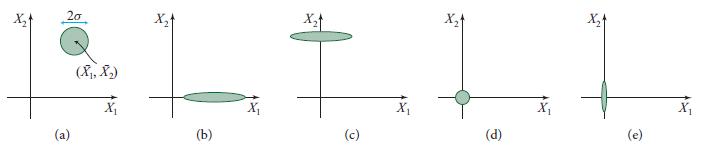
Fig. 10.15
E x R(Ae (ksz@st)) = X cos(kz wst) + X sin(kz - wst). - (10.58)
Step by Step Solution
3.27 Rating (162 Votes )
There are 3 Steps involved in it
a Normal classical light has equal amounts of noise in its two quadratures X and X meaning that the noise in the amplitude and in the phase are the same This can be represented by a circle in the quad... View full answer

Get step-by-step solutions from verified subject matter experts
 Study Help