







Question: A current density j 1 (r) exp(it ) produces fields E 1 (r) exp(it) and B 1 (r) exp(it ). A second current density
A current density j1(r) exp(−iωt ) produces fields E1(r) exp(−iωt) and B1(r) × exp(−iωt ). A second current density j2 exp(−iωt ) produces fields E2(r) exp(−iωt) and B2(r) × exp(−iωt ).
(a) If V is a volume bounded by a surface S, prove the Lorentz reciprocity theorem:
![[dr@2] Ho V dr (EjE -j) = fas S ds (E x](https://dsd5zvtm8ll6.cloudfront.net/si.experts.images/questions/2023/07/64c655b0dcc44_66464c655b06be97.jpg)
(b) Specialize to a spherical volume which both encloses the current sources and is large enough that all the fields on S can be taken to be radiation fields. Prove that
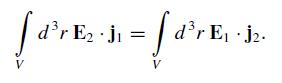
(c) Specialize further to time-harmonic point electric dipole sources located at r1 and r2. If pk is the dipole moment of the kth dipole, prove that

Lorentz reciprocity is used to prove that the angular distribution of power radiated by an antenna in broadcast mode is identical to the angular distribution of power absorbed by the same antenna in receiving mode.
[dr@2] Ho V dr (EjE -j) = fas S ds (E x B E x B). -
Step by Step Solution
3.40 Rating (178 Votes )
There are 3 Steps involved in it
a b c The Maxwell curl equations for a timeharmonic sources are V x ... View full answer

Get step-by-step solutions from verified subject matter experts
 Study Help