



Question: The arithmeticgeometric inequality By applying the arithmeticgeometric inequality to the first two terms of this inequality, deduce that implies x + y 2 x+y 2
The arithmetic–geometric inequality
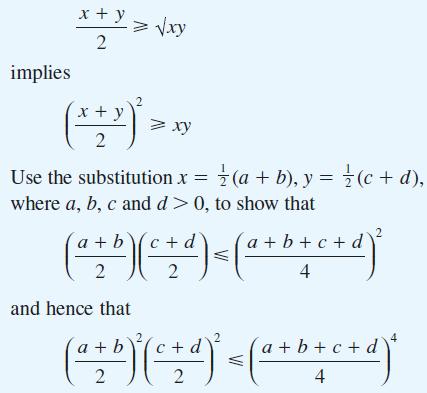
By applying the arithmetic–geometric inequality to the first two terms of this inequality, deduce that
![abcd and hence (a+b+c+d] c + d ) a+b+c+d 4 4 ->Nabcd](https://dsd5zvtm8ll6.cloudfront.net/images/question_images/1704/1/8/3/1726593c5848c1b71704183154329.jpg)
implies x + y 2 x+y 2 > xy >xy Use the substitution x = (a + b), y = 2(c + d), where a, b, c and d > 0, to show that and hence that ( + b )( + d ) = (a + b + c + d ) 2 2 4 2 d) = (+b+c+d)* 4 a+b (a + b)(e = (c + 2 2
Step by Step Solution
★★★★★
3.31 Rating (148 Votes )
There are 3 Steps involved in it
1 Expert Approved Answer
Step: 1 Unlock

zxy Substituting x a b and ycd gives ab... View full answer
Question Has Been Solved by an Expert!
Get step-by-step solutions from verified subject matter experts
Step: 2 Unlock
Step: 3 Unlock