







Question: An article in Information Security Technical Report, Malicious SoftwarePast, Present and Future (Vol. 9, 2004, pp. 618), provided the following data on the top 10
An article in Information Security Technical Report,
“Malicious Software—Past, Present and Future” (Vol. 9, 2004, pp. 6–18), provided the following data on the top 10 malicious software instances for 2002. The clear leader in the number of registered incidences for the year 2002 was the Internet worm
“Klez,” and it is still one of the most widespread threats. This virus was first detected on October 26, 2001, and it has held the top spot among malicious software for the longest period in the history of virology.
The 10 Most Widespread Malicious Programs for 2002.
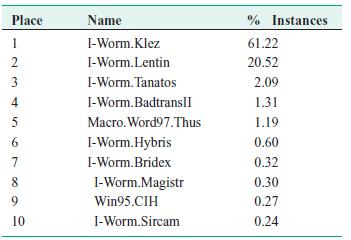
Suppose that 20 malicious software instances are reported.
Assume that the malicious sources can be assumed to be independent.
(a) What is the probability at least one instance is “Klez”?
(b) What is the probability that three or more instances are “Klez”?
(c) What is the mean and standard deviation of the number of “Klez” instances among the 20 reported?
Place Name 1 I-Worm.Klez % Instances 61.22 23 I-Worm.Lentin I-Worm. Tanatos 20.52 2.09 4 I-Worm. BadtransII 1.31 5 Macro. Word97.Thus 1.19 6 I-Worm. Hybris 0.60 7 I-Worm. Bridex 0.32 8 I-Worm.Magistr 0.30 9 Win95.CIH 0.27 10 I-Worm.Sircam 0.24
Step by Step Solution
There are 3 Steps involved in it

Get step-by-step solutions from verified subject matter experts
 Study Help