



Question: Exercise 22 from Chapter 9 gave the following data on amount (oz) of alcohol poured into a short, wide tumbler glass by a sample of
Exercise 22 from Chapter 9 gave the following data on amount (oz) of alcohol poured into a short, wide tumbler glass by a sample of experienced bartenders 2.00, 1.78, 2.16, 1.91, 1.70, 1.67, 1.83, 1.48. The cited article also gave summary data on the amount poured by a different sample of experienced bartenders into a tall, slender (highball) glass; the following observations are consistent with the reported summary data: 1.67, 1.57, 1.64, 1.69, 1.74, 1.75, 1.70, 1.60.
a. What does a comparative boxplot suggest about similarities and differences in the data?
b. Carry out a test of hypotheses to decide whether the true average amount poured is different for the two types of glasses; be sure to check the validity of any assumptions necessary to your analysis, and report a P-value.
Data From Chapter 9 Exercise 22
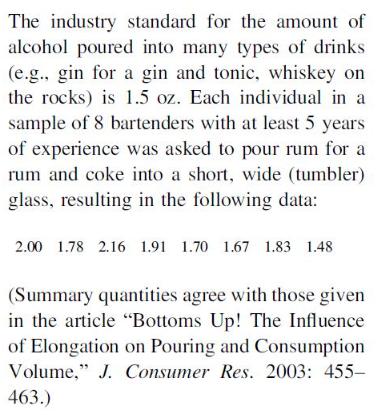
The industry standard for the amount of alcohol poured into many types of drinks (e.g., gin for a gin and tonic, whiskey on the rocks) is 1.5 oz. Each individual in a sample of 8 bartenders with at least 5 years of experience was asked to pour rum for a rum and coke into a short, wide (tumbler) glass, resulting in the following data: 2.00 1.78 2.16 1.91 1.70 1.67 1.83 1.48 (Summary quantities agree with those given in the article "Bottoms Up! The Influence of Elongation on Pouring and Consumption Volume," J. Consumer Res. 2003: 455- 463.)
Step by Step Solution
3.36 Rating (165 Votes )
There are 3 Steps involved in it
Lets go through each part of the question stepbystep Part a Comparative Boxplot Constructing the Boxplots Short Wide Tumbler Glass Data Data 200 178 2... View full answer

Get step-by-step solutions from verified subject matter experts