







Question: A second-degree polynomial with values p(x) = y 0 + y 1 x + y2x 2 is non-negative everywhere if and only if which in
A second-degree polynomial with values p(x) = y0 + y1x + y2x2 is non-negative everywhere if and only if
![[F][/] 0 Yo Y1/2 X Y1/2 Y2 Vx: X 1 1](https://dsd5zvtm8ll6.cloudfront.net/si.question.images/images/question_images/1675/6/9/8/92863e122f088d3b1675698929059.jpg)
which in turn can be written as an LMI in y = (y0, y1, y2):

In this exercise, you show a more general result, which applies to any polynomial of even degree 2k (polynomials of odd degree can’t be non-negative everywhere). To simplify, we only examine the case k = 2, that is, fourth-degree polynomials; the method employed here can be generalized to k > 2.
1. Show that a fourth-degree polynomial p is non-negative everywhere if and only if it is a sum of squares, that is, it can be written as
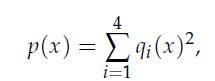
where qi’s are polynomials of degree at most two.

for some appropriate real numbers ai, bi, i = 1, 2, and some p0 ≥ 0.
2. Using the previous part, show that if a fourth-degree polynomial is a sum of squares, then it can be written as.

for some positive-semidefinite matrix Q.
3. Show the converse: if a positive semi-definite matrix Q satisfies condition (11.25) for every x, then p is a sum of squares.
4. Show that a fourth-degree polynomial 
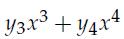 is non-negative everywhere if and only if there exist a 5 x 5 matrix Q such that

[F][/] 0 Yo Y1/2 X Y1/2 Y2 Vx: X 1 1
Step by Step Solution
3.36 Rating (159 Votes )
There are 3 Steps involved in it
1 A fourthdegree polynomial that is everywhere nonnegative must have no real roo... View full answer

Get step-by-step solutions from verified subject matter experts
 Study Help