







Question: A compound microscope consists of two converging lenses, the objective lens and the eyepiece lens, positioned on a common optical axis (Figure 33.47). The objective
A compound microscope consists of two converging lenses, the objective lens and the eyepiece lens, positioned on a common optical axis (Figure 33.47). The objective lens is positioned to form a real, highly magnified image 1 of the sample being examined, and the eyepiece lens is positioned to form a virtual, further magnified image 2 of image 1 . It is image 2 that the user sees. A knob on the microscope allows the user to move the objective lens upward and downward to change both the sample-objective lens distance and the distance between the two lenses.
(a) How must the sample and the two lenses be positioned relative to one another so that the user sees a highly magnified, virtual image of the sample?
(b) What is the overall magnification produced by the microscope?
Data from Figure 33.47
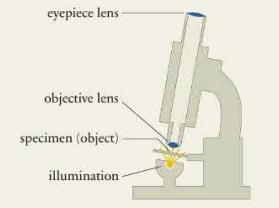
eyepiece lens objective lens specimen (object) illumination
Step by Step Solution
There are 3 Steps involved in it
Part a How must the sample and the two lenses be positioned relative to one another so that the user sees a highly magnified virtual image of the samp... View full answer

Get step-by-step solutions from verified subject matter experts
 Study Help