







Question: For a light ray that crosses the interface between medium 1 having index of refraction (n_{1}) and medium 2 having index of refraction (n_{2}), what
For a light ray that crosses the interface between medium 1 having index of refraction \(n_{1}\) and medium 2 having index of refraction \(n_{2}\), what relationship between \(\theta_{1}\) and \(\theta_{2}\) follows from Fermat's principle (page 1155)?
Data from page 1155
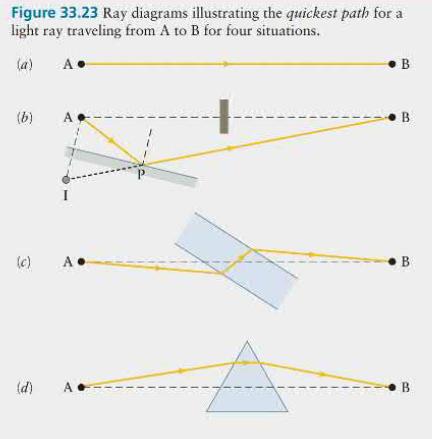
Figure 33.23 shows four ways in which a light ray can travel between two locations A and B: directly, reflected from a mirror, refracted through a glass slab, and refracted through a prism.* You could say that in each case the ray reaches B because it is aimed properly from A. However, an entirely different way of looking at the path followed by the light was suggested by the French mathematician Pierre de Fermat (1601-1665) in a formulation today known as Fermat's principle: The path taken by a light ray between two loca- tions is the path for which the time interval needed to travel between those locations is a minimum.
Step by Step Solution
3.39 Rating (152 Votes )
There are 3 Steps involved in it
To derive the relationship between the angles theta1 and theta2 when a light ray crosses the interface between two media with different indices of ref... View full answer

Get step-by-step solutions from verified subject matter experts
 Study Help