







Question: A small-angle approximation was used to derive Eq. 15. 31, (tau=-(m ell g) vartheta .(a)) What constitutes small in this context? In other words, how
A small-angle approximation was used to derive Eq. 15. 31, \(\tau=-(m \ell g) \vartheta .(a)\) What constitutes small in this context? In other words, how large can \(\vartheta\) be before it can no longer be called small? (b) As a quantitative benchmark, how large does \(\vartheta\) have to be before \((m \ell g) \vartheta\) deviates by more than \(1 \%\) from the true value of \(\tau\) ?
Data from Eq. 15. 31
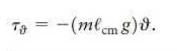
-(mlcmg)d.
Step by Step Solution
★★★★★
3.47 Rating (150 Votes )
There are 3 Steps involved in it
1 Expert Approved Answer
Step: 1 Unlock

Question Has Been Solved by an Expert!
Get step-by-step solutions from verified subject matter experts
Step: 2 Unlock
Step: 3 Unlock
 Study Help