







Question: Suppose the electrostatic work done on a charged particle as it moves along the gray path from (A) to (C) in Figure (25.6 c) is
Suppose the electrostatic work done on a charged particle as it moves along the gray path from \(A\) to \(C\) in Figure \(25.6 c\) is \(W\). What is the electrostatic work done on the particle
(a) along the path from \(\mathrm{C}\) to \(\mathrm{B}\) to \(\mathrm{A}\) and
(b) along the closed path from A to \(\mathrm{C}\) to \(\mathrm{B}\) and back to \(\mathrm{A}\) ?
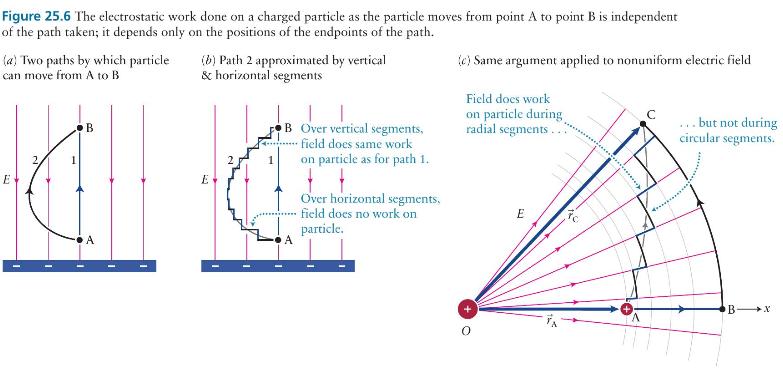
Figure 25.6 The electrostatic work done on a charged particle as the particle moves from point A to point B is independent of the path taken; it depends only on the positions of the endpoints of the path. (a) Two paths by which particle can move from A to B E B (b) Path 2 approximated by vertical & horizontal segments 1 E B Over vertical segments, field does same work on particle as for path 1. Over horizontal segments. field does no work on particle. (c) Same argument applied to nonuniform electric field Field does work on particle during radial segments. E ... but not during circular segments. A A B x
Step by Step Solution
3.40 Rating (156 Votes )
There are 3 Steps involved in it

Get step-by-step solutions from verified subject matter experts
 Study Help