







Question: (a) Is the potential difference along any path from A to (mathrm{C}) in Figure (25.6 c) positive, negative, or zero? ((b)) Along any path from
(a) Is the potential difference along any path from A to \(\mathrm{C}\) in Figure \(25.6 c\) positive, negative, or zero? \((b)\) Along any path from \(\mathrm{C}\) to \(\mathrm{B}\) ?
(c) Along the straight path from \(\mathrm{B}\) to A?
(d) In Figure 25.4, is the potential difference between the particle's initial and final positions positive, negative, or zero?
(e) Express this potential difference in terms of the change in the particle's kinetic energy \(\Delta K\) and its charge \(q\).
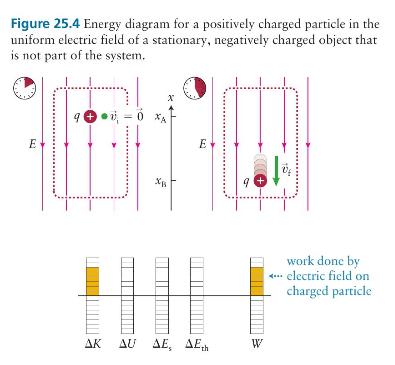
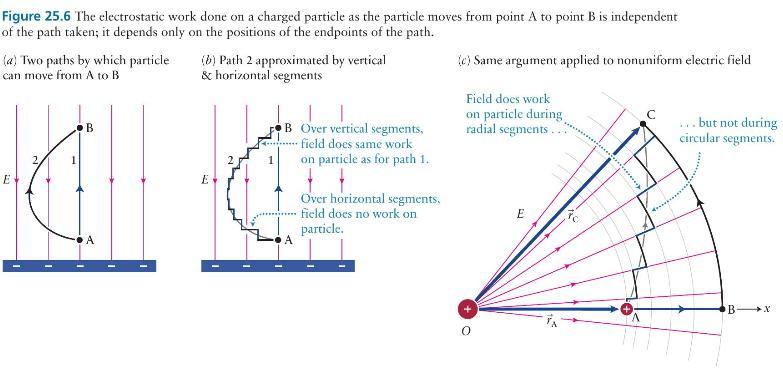
Figure 25.4 Energy diagram for a positively charged particle in the uniform electric field of a stationary, negatively charged object that is not part of the system. 9 + XA E E 9 + AK AU AE, AEth W work done by *** electric field on charged particle
Step by Step Solution
3.36 Rating (159 Votes )
There are 3 Steps involved in it
a Negative because the electrostatic work done on a positively charged particle moving along an... View full answer

Get step-by-step solutions from verified subject matter experts
 Study Help